
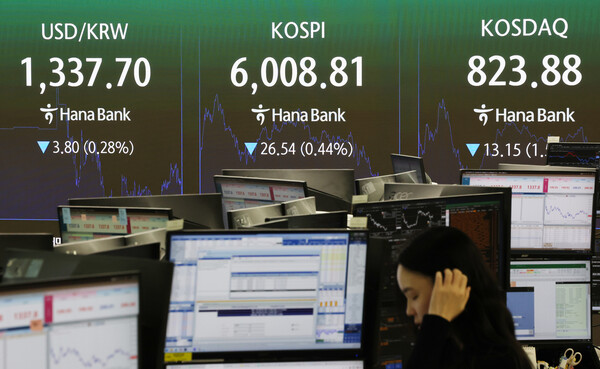
The KOSPI, which plunged the previous day, rebounded more than 2 percent in early trade to regain the 6,100 level. It later gave up all gains as foreign selling intensified. The index slid again to as low as the 5,900 level during the session before barely holding above 6,000.
On Oct. 14, the KOSPI closed down 26.54 points, or 0.44 percent, at 6,008.81. It opened up 26.73 points, or 0.44 percent, at 6,062.08. Early bargain hunting lifted it to as high as 6,190.65, bringing it back above 6,100.
Foreign investors were net sellers of 1.18 trillion won, dragging the index lower. Foreigners had been net buyers of 44.2 billion won early in the session before switching to net selling. Retail investors were also net sellers of 314.3 billion won, while institutions were net buyers of 808.5 billion won.
Top stocks by market capitalisation also gave back most of their gains from early trade.
Samsung Electronics ended unchanged from the previous session at 232,000 won. SK Hynix closed down 1.66 percent at 1,419,000 won.
Elsewhere, SK Square fell 0.58 percent, Hyundai Motor lost 0.48 percent, KB Financial Group dropped 1.97 percent, Samsung Biologics slipped 1.99 percent and Samsung Life fell 3.71 percent.
LG Energy Solution rose 2.93 percent, while Samsung Electro-Mechanics gained 0.81 percent.
The Kosdaq closed down 13.15 points, or 1.57 percent, at 823.88. It weakened from early trade and losses widened in the afternoon.
The won-dollar exchange rate was 1,337.20 won, down 5.80 won from the previous session.
Domestic stocks jumped strongly early in the session on bargain hunting after the previous day's sharp fall, but failed to sustain gains through the close. Bargain hunting emerged in the morning the previous day, but uncertainty about the recent semiconductor cycle and subdued investor sentiment persisted, increasing volatility.
Han Ji-young (한지영), a researcher at Kiwoom Securities, said a rebound could emerge early in the session as bargain hunting follows steep declines over the past 5 consecutive sessions. But she said, "With investment sentiment having cooled in a short period, there appears to be a limit to expecting a shift in mood such as 'the end of the bad-news phase' in just a day or two."
 Oh Sang-yeop
yub@d-today.co.kr
Oh Sang-yeop
yub@d-today.co.kr