
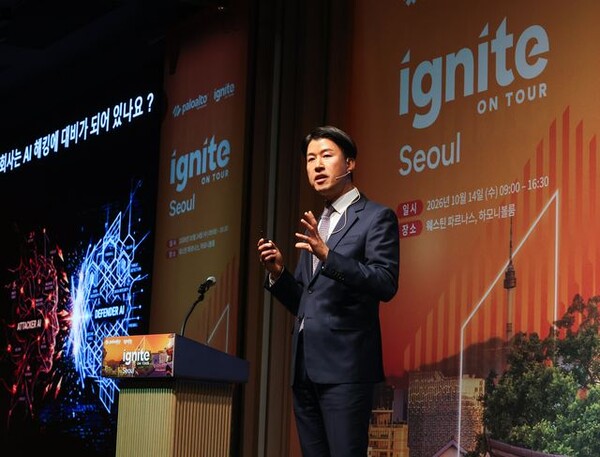
"We need to prepare on the assumption that a mythos-class AI hacks our company. We must pursue AI transformation (AX) and cybersecurity transformation (CX) at the same time."
Park Sang-gyu (박상규), head of Palo Alto Networks Korea, took the stage on Oct. 14 for a keynote speech at the company's "Ignite on Tour Seoul 2026" event. He raised the question of whether companies are ready to fight AI with AI and stressed that point.
Park described this year as a turning point for AI hacking. He cited the emergence of Anthropic Mythos and an incident in which an OpenAI model hacked Hugging Face as major turning points.
He also mentioned a recent situation in which major banks were breached by hacking using AI tools and personal information was leaked. He called it "the most basic AI hacking" and said even top banks that would have thoroughly checked their systems were hit. "We need to prepare based on the worst-case scenario," he said. "AI hacking is not a story from a faraway country. It is already happening around us, and no one can deny it," he said. He said companies have spent huge sums on digital transformation and are now focused on AX, but without AI security, AX efforts would be a house of cards. He repeatedly stressed that CX must be pursued together with AX.
Park also presented 10 commandments for CX.
The first is to check vulnerabilities with top-performance frontier AI. "If you look only at parts with a lower model, you don't know where a hole will break out," Park said. He said the scope should be expanded to the entire internet touchpoint. He also said Palo Alto Networks is the only place in South Korea that can check vulnerabilities with Mythos.
The second is constant preparedness. "Looking at the pace of AI development over the past six months, it is hard even to gauge what the next six months will look like," Park said. He said that even if patching is completed this time, a stronger model will emerge in a few months. He said Palo Alto provides a "continuous defence" model through its threat research group Unit 42 that blocks attacks year-round and advances response systems.
The third is to cooperate with external expert groups. "Even if in-house red and blue teams are capable, they lack experience responding to frontier AI," Park said. He said Palo Alto Networks is working with Anthropic, OpenAI and Nvidia, and formed a Unit 42 Korea organisation last year.
The fourth is virtual patching. "Corporate software that mixes next-generation systems, open source and packages takes 1 to 2 years to fix all vulnerabilities," Park said. He said that in the meantime, attacks must be blocked at the firewall level through virtual patching.
The fifth is to update security assets and replace layer 4 (L4) firewalls with next-generation layer 7 (L7) firewalls. Park said L4 equipment failed to catch ransomware in a recent incident.
The sixth is zero trust, especially building SASE (Secure Access Service Edge). Park said many hacks of South Korean companies occurred through virtual private networks (VPNs), and if a VPN is breached, all company operations stop. He said companies should remove VPNs and VDI (virtual desktops) and switch to SASE.
The seventh is browser security. Park said that since employees, partners and customers all use services through browsers, the browser is the fastest zero-trust route.
The eighth is security for AI itself. Park said managing company-wide tokens with an AI gateway can also reduce costs.
The ninth is automation of monitoring. He stressed the need for automation, saying that even monitoring centres running around the clock at a cost of hundreds of billions of won did not realise for a day or two after hackers had already taken data.
The final, 10th, is integrated identity management. Park said machine and agent accounts have grown to several times the number of human accounts, and that identities of people and AI agents must be managed in an integrated way.
Park also stressed cooperation with South Korean companies. According to the company, Palo Alto Networks Korea has built a system with Samsung Fire & Marine Insurance and legal services companies to provide everything at once from cyber insurance before hacking to legal support after hacking. It is also active in nurturing talent by running security academies with Seoul IT High School, Dongguk University and Daejeon University.
It has also prepared a programme to help defence companies obtain security certification (CMMC) needed to enter overseas markets. Park said the company has recently worked with South Korean offensive security specialist Ankey Whitehat to provide financial-sector customers with security services covering everything from offensive diagnostics to defence.
 Chi-gyu Hwang
delight@d-today.co.kr
Chi-gyu Hwang
delight@d-today.co.kr