
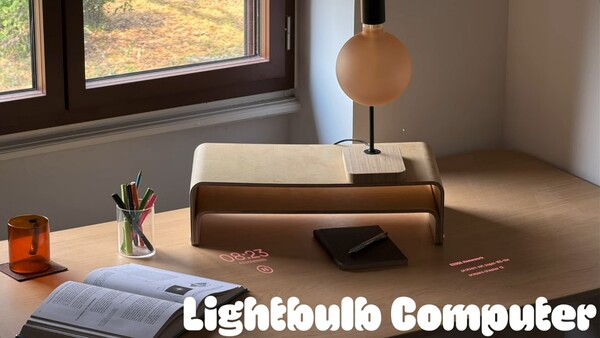
A future computer that uses walls, desks and ceilings as screens without a separate monitor could emerge. The concept combines a projector and computer vision technology in a lightbulb-shaped device to use an entire everyday space as a digital display.
Gigazine, a Japanese media outlet, reported on Oct. 13 that Guillaume Ardaud (기욤 아르도), who worked at Apple for more than 8 years as a prototype developer and designer, unveiled a future PC concept called the Lightbulb Computer.
The device is designed to resemble a large lightbulb. It can be mounted on a portable stand or installed in light sockets on walls and ceilings, projecting information onto surrounding surfaces.
The core is the combination of a projector and computer vision. It recognises users' voice commands and hand gestures, analyses nearby objects and spaces, and displays needed information in appropriate locations.
In a released demo video, saying "Hey Lightbulb" in a kitchen made a recipe appear on a wall. When a user asked a question while reading a book, it displayed an answer on the desk. When planning a trip, it projected a large map onto the desk.
The projected screen was also implemented to allow operations such as touching or scrolling with a finger. The demonstration also presented uses such as displaying smartphone photos on a wall or playing games.
It can also be used to control smart home devices. When a user points to a particular appliance and commands, "Turn that on," it recognises the target without the user naming the device.
A function that finds a desired book on a bookshelf and marks it with light was also introduced. It is an example of using visual recognition technology that quickly analyses the surrounding environment.
Ardaud said, "Smart glasses and headsets have limitations such as the burden of wearing them and restricted interaction." He added, "Using the space itself as a screen could be an alternative."
It is not yet at the commercialisation stage. The released video was filmed with large prototype equipment and did not use video editing, special effects or AI-generated images, it said. Issues including miniaturisation, projection performance and privacy protection remain to be resolved.
 Jae-won Choi
ittt_0801@d-today.co.kr
Jae-won Choi
ittt_0801@d-today.co.kr