
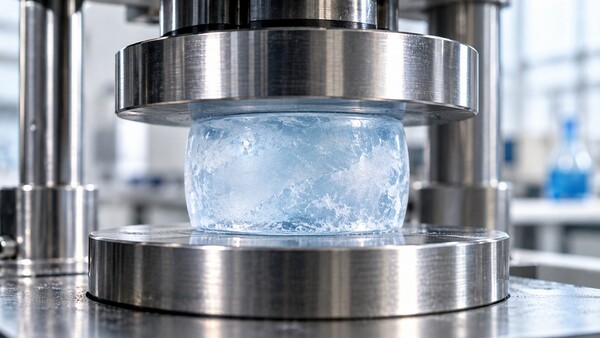
A new ice composite has been developed that has about 10 times the compressive strength of ordinary ice and does not break easily. It achieves strength close to concrete, raising the possibility it could be used as an eco-friendly building material in polar regions.
On Oct. 14 local time, Japanese media outlet Gigazine reported that a research team involving Israel's Hebrew University developed BioPykrete, an ice composite that combines plant-derived materials and proteins.
Ordinary ice cracks quickly and breaks under strong pressure. By contrast, BioPykrete does not suddenly break under pressure and instead deforms gradually.
The key is a fine mesh structure formed inside the ice. The team mixed cellulose nanocrystals (CNC) obtained from plant cell walls into water and froze it in one direction. In the process, the CNC formed a mesh and ice crystals settled in between.
The team also added a fusion protein made by linking fish-derived antifreeze protein AFPIII and cellulose-binding protein CBM3a. The protein acts as an adhesive that connects the ice and CNC at a molecular level.
The team made cylindrical samples measuring 2 cm in diameter and 1 cm in height and carried out compression tests.
BioPykrete's compressive strength was about 10 times higher than that of ordinary ice. It was also about 2 times stronger than a composite made without the fusion protein.
The energy absorbed before failure was about 70 times that of ordinary ice. The team explained that the CNC mesh suppressed crack propagation and the fusion protein increased internal bonding strength.
The team assessed that BioPykrete has compressive strength close to that of ordinary concrete and could be used as a building material in extreme environments such as the Arctic and Antarctica.
It is still at the experimental stage using small samples. For use in actual construction, additional verification is needed, including long-term durability, repeated freeze-thaw cycles and deformation under sustained loads.
 Jae-won Choi
ittt_0801@d-today.co.kr
Jae-won Choi
ittt_0801@d-today.co.kr