
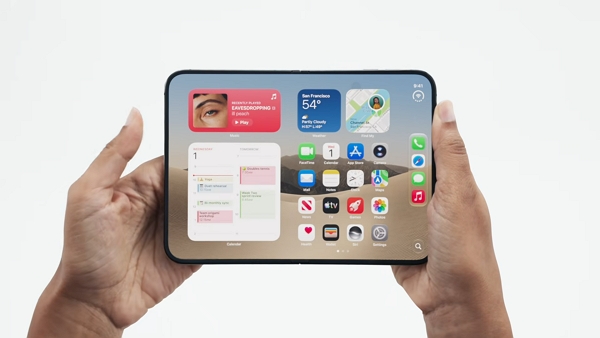
[DigitalToday reporter Jinju Hong] Apple’s first book-style foldable phone, the iPhone Duo, is facing off against Xiaomi’s 18 Fold with a similar design. Both use a passport-style form factor that can be used like a tablet when unfolded. They differ clearly in cameras, battery, software and price. Xiaomi appears to be leaning on hardware specifications and price competitiveness, while Apple seeks differentiation through durability and an iOS-based user experience.
On Oct. 13 (local time), IT outlet Engadget reported that the two products were unveiled only days apart. It said they adopt an elongated, passport-like design rather than the near-square aspect ratios common in existing foldables.
Both phones measure 7.6 inches when unfolded and 5.4 inches when folded. Both the inner and outer displays support a 120 Hz refresh rate, making their basic display specifications similar. Maximum brightness differs, with the Xiaomi 18 Fold at 4,000 nits and the iPhone Duo at 3,000 nits.
Apple focuses on reducing screen reflections and creases. It applied a nano-texture layer to the inner display and designed the front-facing camera to be hidden under the screen and appear only when needed. This underscores visibility in real-world use and display finish rather than simply raising brightness.
Differences also appear in durability and materials. The iPhone Duo uses a titanium frame and Ceramic Shield glass and supports an IP68 water and dust resistance rating. The Xiaomi 18 Fold uses an aluminium frame and its own Shield Glass 3.0. Xiaomi did not disclose a water and dust resistance rating.
Xiaomi has the advantage on weight. The Xiaomi 18 Fold weighs 219 grams, 35 grams lighter than the 254-gram iPhone Duo. Engadget rated Xiaomi’s device as one of the lightest foldables on the market. As foldables can feel heavier than standard smartphones, Xiaomi’s design could appeal to consumers who value portability and long use.
In the performance race, both companies highlight in-house designed chips. The iPhone Duo uses the 2-nanometre process-based A20 Pro to improve power efficiency. The Xiaomi 18 Fold uses the 3-nanometre process-based XRING O3.
Xiaomi offers more memory. The Xiaomi 18 Fold comes with 16 GB of RAM, while the iPhone Duo provides 12 GB. Actual performance can also vary with the operating system, chip design and app optimisation, making it hard to judge superiority on capacity alone.
The biggest difference between the two products stands out in cameras. The iPhone Duo has a dual camera made up of a 48-megapixel wide-angle and a 48-megapixel ultra-wide. A separate optical-zoom camera used in iPhone Pro models is absent. That increases reliance on digital zoom when shooting distant subjects.
The Xiaomi 18 Fold offers more aggressive camera specifications. It has a 200-megapixel main camera, a 50-megapixel ultra-wide and a 50-megapixel optical-zoom camera. Engadget rated Xiaomi’s camera setup as more impressive. For consumers expecting camera performance befitting a high-priced product, Xiaomi’s optical-zoom camera could look more attractive.
Battery and charging speed are also Xiaomi strengths. The Xiaomi 18 Fold has a 6,000 mAh silicon-carbon battery and supports 67-watt wired charging and 50-watt wireless charging. The iPhone Duo supports 60-watt wired charging and 35-watt MagSafe wireless charging. Apple has not disclosed battery capacity, making actual usage time hard to compare directly.
Apple, meanwhile, presents the software experience as a differentiator. iOS 27 adds Split View multitasking that allows users to split the screen to do multiple tasks at once, along with Siri AI. Apple Pencil support is also due to be introduced later this year. Apple also highlights animations and app optimisation tailored for foldable screens.
This suggests that user experience not visible from hardware specifications alone could decide real competitiveness. The completeness of multitasking and app optimisation, however, can be compared accurately only by using the features on actual products.
Xiaomi has the edge on price. The iPhone Duo starts at $1,999 (about 2.67 million won), with preorders set for Oct. 16 and a formal release scheduled for Oct. 23. The Xiaomi 18 Fold starts at 10,999 yuan (about 2.19 million won), which is about $1,640 when converted into dollars. Based on starting prices alone, Xiaomi’s device is about $360 cheaper.
Availability by region is a variable. The Xiaomi 18 Fold is currently exclusive to the China market and is not officially sold in the United States, and it has not received local carrier certification. Even at a lower price, overseas consumers, including in the United States, face constraints in buying through official distribution channels and using telecom services.
The two products use a similar form factor but push different strengths. The Xiaomi 18 Fold emphasises hardware competitiveness including cameras, battery, weight and price, while the iPhone Duo seeks differentiation centred on durability, display design and the iOS ecosystem. Xiaomi could emerge as a strong alternative to the iPhone Duo in China, but competition in the global market is expected to vary depending on sales regions and actual user experience.
 Jinju Hong
hongjj@d-today.co.kr
Jinju Hong
hongjj@d-today.co.kr