
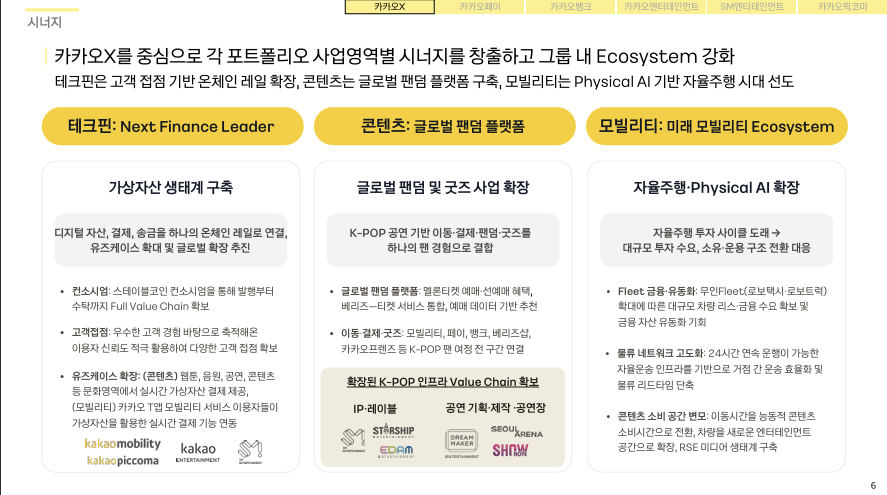
Kakao plans to connect services across its finance, content and mobility affiliates to broaden its growth base. It aims to expand the use of its existing users, intellectual property (IP) and business base, focusing on crypto payments, AI video and autonomous driving.
The industry said on Tuesday that Kakao unveiled mid- to long-term growth plans for key subsidiaries at an analyst meeting a day earlier. It plans to allocate investment resources centered on KakaoX, which will remain as the surviving entity after a spin-off, and to support business, technology and data link-ups across affiliates.
KakaoX aims to achieve more than 10 trillion won in revenue by 2030 through affiliate growth and improved investment efficiency. Based on combined affiliate revenue of 5.6 trillion won last year, it forecast average annual growth of about 13 percent. The figure excludes revenue at KakaoBank, which is not a consolidated subsidiary.
The expansion of crypto payment use cases...Pushes link-ups with content and KakaoT
In finance, it plans to build an ecosystem spanning issuance to custody through a stablecoin consortium. It aims to link digital assets with payments and remittances and to use user touchpoints held by affiliates to expand use cases and the scope of global business.
Specifically, it plans to offer real-time crypto payments for content services such as webtoons, music and performances. It also plans to link payment functions to KakaoT mobility services. The aim is to connect functions secured in financial services to everyday transactions such as content purchases and travel.
KakaoPay plans to expand its existing digital wallet into blockchain-based financial services. It aims to broaden use cases to include online and offline payments and overseas remittances, as well as payment means for AI agents and the trading and custody of tokenised assets.
From reading to video and products...Expands Piccoma growth engines
In content, it plans to expand consumption of video, performances and products based on original IP and fandom. It plans to combine Kakao Entertainment's ability to supply domestic webtoon and web novel IP with Piccoma's overseas reader touchpoints, and to broaden media collaborations using music IP and artists.
Piccoma set AI video, a BL-genre specialised service and character merchandising as new growth engines in response to slowing growth in Japan's e-comic market and consumption shifts toward video and AI content.
It plans to expand new businesses so it can grow even as revenue from existing services declines gradually due to maturity in the reading market. It plans to revitalise existing businesses by linking AI video viewing and product purchases to viewing original works, and to secure additional revenue from new services.
For AI animation, it plans to serialise about 80 titles by the end of this year and to build a system of up to two weekly instalments. From next year, it will expand into AI live-action video and animation production based on novel originals. It also plans to diversify content formats, including audiobooks and AI video illustrations.
Piccoma's paid revenue from AI animation in September rose to 4.5 times the level in May, the first month after the service launched. Some 12 percent of animation users came in as new readers of the original works. Piccoma plans to link video viewing to consumption of original works to expand animation and webtoon revenue together.
Piccoma Kuji, a character merchandise business, launched in December last year centered on popular webtoon titles. It plans a phased expansion by broadening merchandise targets to Japanese comics this year and linking with offline distribution channels such as overseas stores from next year. It also plans to set up a specialised service for the BL genre to secure user bases that prefer specific genres.
In its global fandom business, it plans to connect Melon Ticket booking and pre-sale benefits with Berryz fan services and push recommendations using booking data. It plans to link merchandise sales services with Kakao Mobility, KakaoPay and KakaoBank to combine travel, payments and product purchases that accompany performance attendance into a single fan experience.
Responds to demand for autonomous driving investment...Expands into vehicle finance and logistics
In mobility, it plans to respond to investment demand arising from the expansion of unmanned vehicles such as robotaxis and robotrucks, and to changes in ownership and operating structures for vehicles. It aims to secure large-scale vehicle leasing and finance demand and to seek opportunities to securitise financial assets, responding to financial demand needed to introduce and operate autonomous vehicles.
In logistics, it plans to use autonomous transport infrastructure capable of 24-hour continuous operation to boost transport efficiency between hubs and reduce transport time. It also plans a business to expand vehicles into new entertainment spaces so travel time can be used as time for content consumption.
KakaoX plans to allocate resources based on investment efficiency and future growth potential to support this business expansion. In addition to new investment and support for affiliate growth, it will also support AI transformation of customer touchpoints and internal operations.
It also plans to form a specialised board of directors focused on capital allocation and investment. It named four people as independent director candidates for KakaoX: Choon-seung Ham (함춘승), Kyung-jin Cha (차경진), Sun-wook Kim (김선욱) and Sang-wook Cho (조상욱).
The performance of the affiliate link-up strategy depends on whether connections between services lead to actual transactions and additional revenue. A monetisation task is to increase the use of crypto payments in content and mobility and connect AI video viewing to viewing original works and buying merchandise.
 Ho-jung Lee
lhj@d-today.co.kr
Ho-jung Lee
lhj@d-today.co.kr