
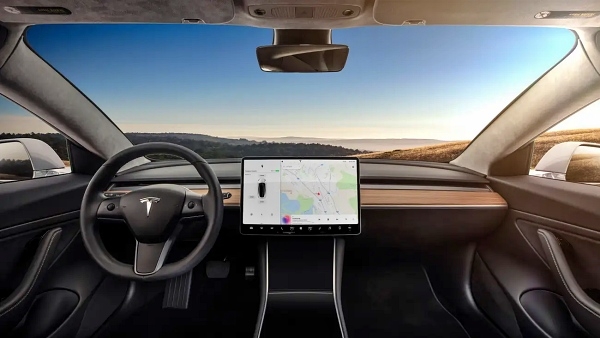
Tesla has changed the name of its driver-assistance feature FSD in Europe to “assisted driving”. The move follows German regulators’ warning that the existing brand name could cause misunderstanding.
With safety standards and regulatory barriers in each country still a variable, Tesla raised pressure by even mentioning loss of life that could occur if approval is delayed. The competition in self-driving technology appears to be shifting beyond performance into a struggle for the initiative over regulation and safety verification.
• Tesla drops “full self-driving” name in Europe amid pushback from regulators • Tesla teams up with Germany to expand across Europe, and even changes the “FSD” name • Tesla’s pressure campaign for European approval of FSD comes to light: “If it is late, people die”
Tesla, which is struggling to overcome regulatory barriers for self-driving technology in Europe, is also moving to expand how its vehicles can be used. By expanding a function that allows the Model 3 and Model Y to be used as a home backup power source, it is broadening its scope beyond a simple means of transport into an energy platform that can supply power to homes during outages.
• Tesla expands home backup power for Model 3 and Model Y to ease blackout worries
As the U.S. electric vehicle market shows signs of a rebound, Tesla has taken center stage in the recovery in sales. U.S. EV sales in the third quarter rose 7.7 percent from the previous quarter, showing a move away from weakness, and Tesla moved ahead of rivals to reaffirm its dominance in the market. With uncertainty persisting, including slowing EV demand and changes in subsidy policy, attention is on whether the rebound will remain a temporary recovery or become a signal of a broader demand recovery.
• U.S. EV market revives, up 7.7 percent in the third quarter, as Tesla “runs alone”
An estimate has emerged that Tesla Cybertruck deliveries in the third quarter this year amounted to about 7,000 to 8,000 vehicles. It is an improvement from a year earlier, but still far short of the large-scale production target that had been presented. The Cybertruck drew attention from the start for its unconventional design and performance, but it remains uncertain whether it can deliver sales results in line with expectations amid high prices and concerns about weakening demand.
• Cybertruck a jackpot or a flop? Third-quarter deliveries seen at up to 8,000
Chinese electric vehicle makers are accelerating global expansion, simultaneously targeting the European and North American markets.
Geely confirmed its entry into the Canadian market in 2027, taking its first step into North America. Aito also formalised plans to enter Europe in the same year as it moved to expand overseas markets. BYD unveiled the seven-seat electric SUV “Atto 8” in Europe, highlighting 5-minute charging and a 652-km driving range, as it stepped up efforts to win local consumers.
• China’s Geely confirms Canada entry; first sales in 2027, model not disclosed • BYD unveils seven-seat electric SUV “Atto 8” in Europe, with 5-minute charging and 652-km range • China’s EV maker Aito formalises Europe entry in 2027
As Chinese EV makers accelerate their push into global markets, Japan’s automakers are also responding with charging-infrastructure innovation and new model launches.
Honda is testing road technology in Japan that wirelessly charges EVs while they are driving, probing the potential to improve charging convenience. Mitsubishi also unveiled the electric SUV “ASX VR-e” with a maximum output of 459 horsepower, moving to strengthen its electrified lineup. Attention is on what changes Japanese automakers’ moves, featuring advances in charging technology and high-performance EVs, could bring to competition in the EV market.
• Charging an EV while driving: Honda tests “wireless-charging road” in Japan • Mitsubishi unveils 459-horsepower electric SUV “ASX VR-e”
Meanwhile, Toyota’s China joint venture FAW Toyota officially denied rumours of large-scale price cuts and a withdrawal from the China market. FAW Toyota said claims spreading online about a “complete exit from the China market” and “large-scale discounted sales” are not true. The company stressed that production and sales of all models and plans to develop follow-on models are proceeding as scheduled, and it underscored that it reserves the right to take legal action over false information.
• “Both price collapse and market exit are lies”: Toyota’s China joint venture issues urgent clarification
Self-driving technology is expanding its use beyond passenger transport into military operations and logistics transport.
Xpeng unveiled the robotaxi “YoYo” as it moved to target the self-driving mobility market. The U.S. Army selected the “Hunter Wolf,” an electric-motor-based autonomous military robot that can manoeuvre in rough terrain. Einride’s autonomous electric truck, which removes the driver’s seat, has also been deployed at U.S. logistics sites, widening the possibilities for unmanned transport. As the fields of application diversify from passenger transport to military and industrial sites, the competition for commercialisation appears to be entering a new phase.
• Xpeng unveils robotaxi “YoYo” in push into self-driving market • U.S. Army selects autonomous military robot “Hunter Wolf,” which runs rough terrain with electric motors • Einride’s driverless autonomous electric truck runs at U.S. logistics sites
In South Korea’s mobility market, A2Z is moving to speed the introduction of next-generation public transport by launching a pilot operation of the autonomous bus “GM1” in Gwangmyeong.
Whistle has also started a parking and stopping enforcement alert service in Donghae that includes out-of-town drivers, improving convenience for motorists. Lotte is seeking to expand its overseas business by showcasing a mobility value chain in Japan covering everything from materials to logistics. As the digital transformation of mobility services and cooperation between companies intersect, the competitive landscape of South Korea’s mobility industry also appears to be broadening.
• A2Z launches pilot operation of autonomous bus “GM1” in Gwangmyeong • Whistle starts enforcement alerts in Donghae, also covering out-of-town drivers • Lotte brings mobility value chain to Japan, covering materials to logistics in one place
Personal mobility is expanding the boundaries of transport by incorporating solar charging, high-capacity batteries and self-driving technology.
In the United States, a two-seat electric scooter that charges with solar power and can run up to 30 km has gone on sale. A three-wheeled electric bicycle that can carry 7 people is also drawing attention with a high-capacity battery of as much as 7.3 kWh. In Switzerland, a self-driving shared bicycle has also appeared that moves on its own when users get on and off.
• Two-seat electric scooter that runs on sunlight goes on sale in the U.S., runs 30 km on solar charging • Three-wheeled electric bicycle that carries 7 people appears, with a 7.3-kWh “monster-level” battery • When you get on and off, the bicycle moves on its own: Switzerland’s “self-driving shared bicycle”
 Jinju Hong
hongjj@d-today.co.kr
Jinju Hong
hongjj@d-today.co.kr