
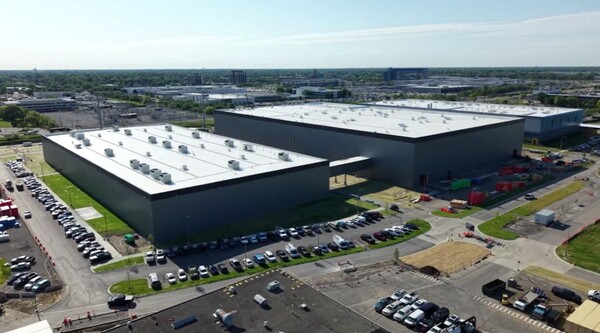
[DigitalToday intern reporter Seung-a Yoo] General Motors has built a battery cell development centre at its Warren campus in Michigan to lower electric vehicle prices.
The Verge, an IT news outlet, reported on Oct. 12 that the facility will validate battery cells developed in laboratories ahead of mass production and optimise manufacturing processes.
GM plans to speed battery development and cut costs to secure price competitiveness for mass-market electric vehicles, as battery packs account for 30 to 40 percent of an EV's total cost. GM, which sells the second-most vehicles in the U.S. electric vehicle market after Tesla, is accelerating work on cheaper batteries to respond to competition from Tesla and Chinese EV makers.
The development centre spans about 465,000 square metres. Mo Gallegos (모 갈레고스), head of the development centre, put the facility cost at $900 million, or about 1.21 trillion won. Its maximum capacity is about 4 to 5 gigawatt hours, but it focuses on process and quality validation rather than mass production. It is designed to produce smaller volumes than a full-scale plant while testing and optimising processes and manufacturing methods.
The first pilot production target is lithium manganese-rich prismatic cells. GM plans to produce its first test cells in the fourth quarter of this year and start mass production in 2028. LMR is a battery chemistry that reduces the use of cobalt and nickel and raises the share of manganese. The centre will later validate sodium-ion prismatic cells for energy storage systems. GM is working with startup Peak Energy, which is developing related technology.
GM is proceeding with battery development in four stages. The Kettering R&D lab develops new chemistries, and the Wallace Battery Cell Innovation Center, which opened in 2023, turns them into large prototypes. The new development centre uses production equipment to make thousands of cells a day and validate processes. GM then passes the technology and data it has secured to mass-production partners, including Ultium Cells, its joint venture with LG Energy Solution, to link to large-scale production.
GM is also using digital twins and artificial intelligence to shorten development time. GM's head of virtual engineering for global propulsion said it simulates manufacturing processes with digital twins before running actual equipment. The plan is to use battery data accumulated over the past 10 years to predict changes in chemistry and processes, and also reduce the time needed to build prototypes directly.
Teh Younee (테유니), the executive in charge, said the company modelled the slurry mixing process and cut mixing time to half of the previous recommended method. GM's vice president for batteries and sustainability said it can also simulate, within days, the results of changing silicon or cobalt content. GM is targeting completion of the entire battery development process in about half the time required previously.
Keltie (켈티), the vice president, said the long-term goal is to significantly reduce physical testing of prototype cells and manufacturing processes. GM is seeking to boost EV price competitiveness by building an in-house system that runs from R&D to process validation and mass production, allowing it to commercialise next-generation batteries faster. Still, it remains to be seen whether this investment will translate into shorter development times and lower costs.
 Seung-a Yoo
ysah@d-today.co.kr
Seung-a Yoo
ysah@d-today.co.kr