
As the government pushes to build an independent low-Earth-orbit satellite communications network by 2035, it has emerged that domestic launch vehicles alone may struggle to launch all the satellites needed.
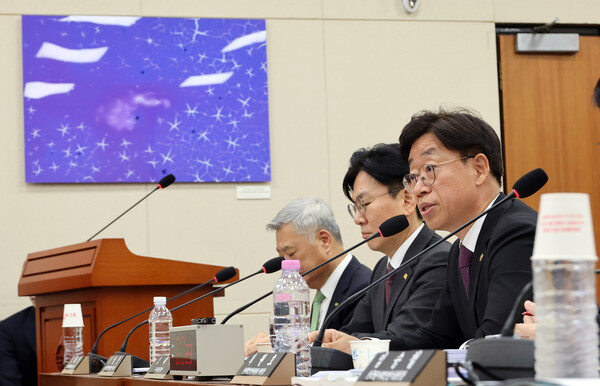
Oh Taeseok (오태석), head of the Korea Aerospace Administration, said at a parliamentary audit by the National Assembly’s Science, ICT, Broadcasting and Communications Committee on Oct. 13 that “the big bottleneck for a low-Earth-orbit satellite communications network is launch vehicles.” He said that, as things stand, Nuri and the next-generation launch vehicle cannot launch all the initial satellites.
The agency is working to secure an independent communications network that can be used even in emergencies such as national security crises and disasters. To that end, it is pushing a project to build a Korean low-Earth-orbit satellite communications network. It is currently reviewing three options: deploying 128, 256 or 512 satellites.
The issue is the means to put satellites into orbit. A large number of satellites must be launched in a short period, but the agency judges that domestic launch capability alone would be hard-pressed to handle it. Oh said that even 128 satellites, let alone 512, cannot all be launched in the first phase, and assessed that foreign launch vehicles would be needed.
During the audit, concerns were also raised that relying on foreign launch vehicles could cause problems such as launch schedule delays. Lee Yeon-hee (이연희), a lawmaker from the Democratic Party, cited repeated postponements of the launch schedule for the Arirang 6 multipurpose satellite and called for standard guidelines to apply to overseas launch contracts for national satellites.
Lawmakers also pointed to South Korea’s slower pace of technology development in the space AI data center field compared with major countries. Lee Ju-hee (이주희), a Democratic Party lawmaker, said the United States and China are already pursuing demonstrations of space AI computing technology, while South Korea plans to launch a verification platform satellite only in 2030. She said core technology development funding reflected in next year’s government budget plan totals about 2.1 billion won and is focused even then on ground verification of key technologies such as power and cooling, arguing that demonstrations need to be brought forward.
Oh agreed that early technology demonstrations are needed, citing the growth potential of the space AI data center market.
Separately, the agency is pushing to develop a reusable next-generation launch vehicle to strengthen launch capability. It aims to verify reusability technology in 2028 with a demonstrator about 12 meters in size and to complete hardware development of a methane-fueled next-generation launch vehicle by 2032.
Oh said there have been some schedule delays in the development process for the next-generation launch vehicle. He said, “There was an aspect of wasting time,” but added that work is now moving quickly on the design to complete the mission as initially targeted.
He said, “By 2032, we will build a launch vehicle that is reusable in hardware terms, and we will advance the technology through actual use after the 2032 lunar landing mission.” The agency expects it could try actual operation of a reusable launch vehicle from 2033.
 Jin-ho Lee
jhlee26@d-today.co.kr
Jin-ho Lee
jhlee26@d-today.co.kr