
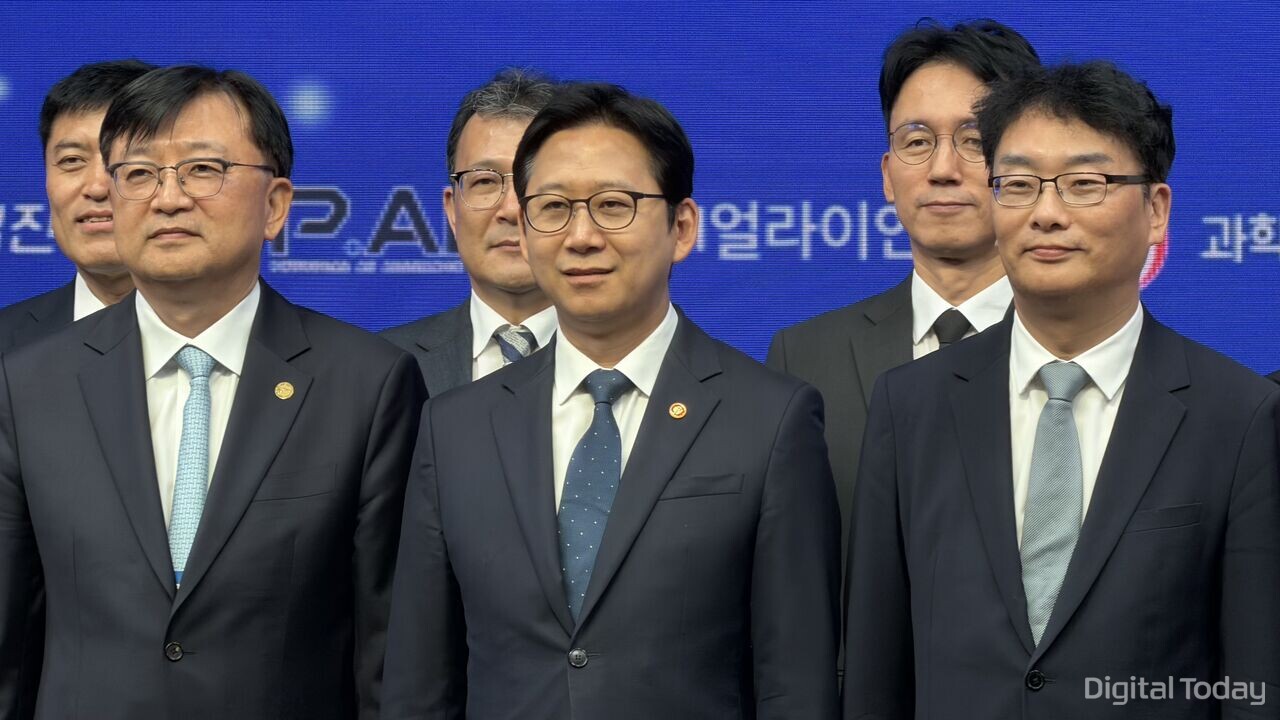
Deputy Prime Minister and Science and ICT Minister Bae Kyung-hoon (배경훈) stressed the government should review whether its current targets and investment scale are sufficient to secure world-class competitiveness in physical AI.
With AI advancing faster than initially expected, he called for setting the highest possible goals with the next 3 to 5 years in mind and speeding up investment and technology development.
At a "Physical AI Alliance roundtable" held at COEX in Seoul’s Gangnam district on Tuesday, Bae said, "In physical AI, we must be prepared enough to dominate the global market." He added, "I keep thinking about whether the plans we have set are sufficient and whether we are executing them in line with our goals."
He cited the fact that superintelligence is already being discussed in the United States and said AI’s pace of development has become much faster than expected last year. He said physical AI should also raise its targets and investment levels rather than settling for earlier projections.
Bae said, "We should set goals so that we will not regret, five years from now, three years from now, or next year, thinking 'we should have invested this much more'." He added, "The government cannot support everything, but I hope we can set the maximum possible goals together with companies."
He added, "If we build high-level goals at the current pace, at some point we could become the world’s No. 1 physical AI powerhouse."
Bae said physical AI can be applied to industrial sites such as manufacturing to create new markets.
He also noted China is actively introducing humanoid robots to industrial sites to accumulate data, and stressed South Korea must speed up technology development and industrial deployment.
Bae said, "The three mega projects are projects driven by the will to create South Korea’s future growth engines with investment now." He added, "We must keep thinking about whether what we are doing is backed by that level of desire, passion and preparation."
The government plans to invest 3.1 trillion won in physical AI next year. That is more than triple this year’s 900 billion won and accounts for about 20 percent of next year’s 16.4 trillion won in all-government AI spending.
He also offered a positive assessment of domestic technology development results. Bae said progress is also being made in securing homegrown AI models and software capabilities that do not depend on overseas solutions, and said it is important to secure technological competitiveness that links these to domestic platforms and hardware.
He said, however, that connecting technology development results to real industrial demand and finding sustainable business models remains a task.
Jang Young-jae (장영재), a Korea Advanced Institute of Science and Technology (KAIST) professor who chairs the governance subcommittee, also said, "Semiconductors and AI data centers have specific products and industries, but physical AI is a technology, and we still need to think about what the product is and what the industry is."
Meanwhile, the number of companies participating in the alliance has increased to 437 from 120 at its launch last year. The alliance aims to expand a cooperation framework that reflects private-sector demand in government research and development projects and links it to demonstration, investment and commercialisation.
Bae said, "Domestic companies should package and generalise collaboration models in physical AI and develop them into an export industry." He added, "From a macro perspective, please share your views on what is lacking in the current goals."
 Seulgi Son
sageson@d-today.co.kr
Seulgi Son
sageson@d-today.co.kr