
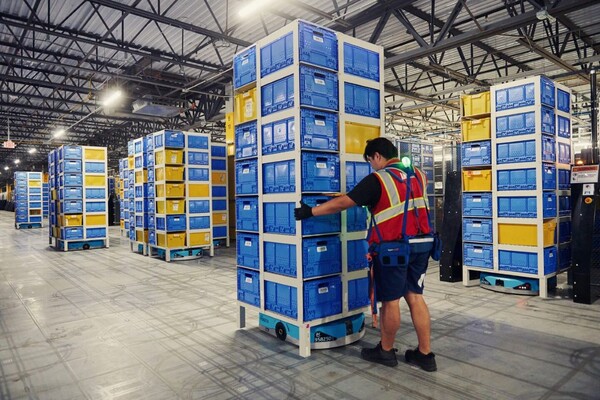
Amazon operates more than 1 million warehouse robots and is expanding robot production and deployment. Some also warn automation can ease worker strain while increasing repetitive tasks and work pace, potentially raising injury risks.
On Oct. 12 (local time), IT outlet Ars Technica reported that Amazon plans to build additional robot production facilities in Austin, Texas, and Greenwood, Indiana.
Amazon is the world’s No. 2 employer, hiring 1,576,000 people including full-time and part-time staff, based on its 2025 annual report. The company says robots take on tasks with high injury risks, such as moving heavy items or retrieving goods from high places, easing the burden on employees. Labor groups and researchers, however, say robots can increase work intensity by pushing up the pace of work.
Amazon has expanded logistics automation since acquiring robotics company Kiva Systems in 2012. Most robots currently are wheeled mobile robots that carry shelves of goods to workers. Amazon Chief Financial Officer Brian Olsavsky (브라이언 올사브스키) said the company plans to more than double the number of robotic arms this year. The company has thousands of robotic arms in operation.
Robotic arms are also evolving. Robin picks up and sorts mixed boxes and envelopes, and Cardinal loads parcels of up to 50 pounds, about 23 kg, onto carts. Sparrow uses an artificial intelligence foundation model to recognize and pick up and move various products. Vulcan combines visual information with force-feedback sensors to place items into or remove them from bins. Amazon plans to expand deployment of Vulcan from 2027.
The impact of automation on worker safety is mixed. A study published in the academic journal ILR Review in April 2025 found that robot-equipped fulfillment centers had 40 percent fewer serious injuries than conventional centers, but 77 percent more minor injuries from repetitive motions. The study used some weekly data from more than 150 Amazon fulfillment centers from 2016 to 2019. Researchers said faster work speeds and more repetitive motions after robots were introduced could be linked to the rise in minor injuries.
Amazon countered that earlier criticism relies on old data from before the latest robots were introduced. The company said its total recordable incident rate has improved by 43 percent since 2019, and the rate of incidents requiring time off has improved by 70 percent. It also said automated facilities need more reliability, maintenance and engineering staff, and the number of robot maintenance technicians has increased by more than 30 percent.
Still, some say automation could reduce future hiring needs. An internal Amazon strategy document reported by The New York Times in October 2025 included a projection that expanding robots could cut expected hiring demand in the United States by more than 160,000 by 2027 and by 600,000 by 2033. Amazon said at the time the document reflected the view of one organization within the company.
As Amazon continues to add robots, securing both productivity gains and worker safety remains a challenge.
 Yoo Seung-a
ysah@d-today.co.kr
Yoo Seung-a
ysah@d-today.co.kr