
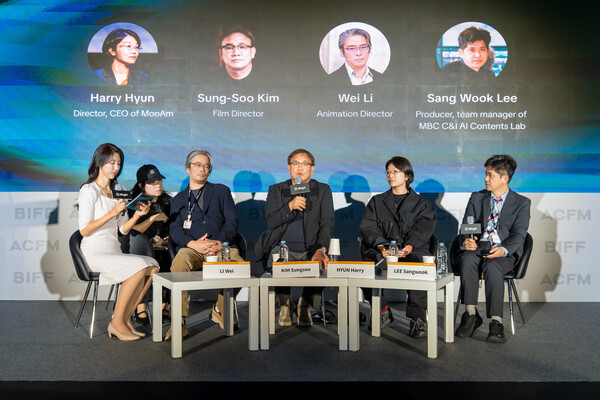
The 2026 Asia Contents & Film Market (ACFM), held in connection with the Busan International Film Festival, took place on Oct. 11 at the Busan Exhibition and Convention Center (BEXCO). AI was also a keyword this time. The event also featured a session where prominent creators from South Korea and China shared their experiences making videos with AI.
AI video generation service Kling AI invited 4 people to the event - a film director, a broadcast producer, the head of a video production studio and an animation director - for a panel discussion titled "New cinematic possibilities: Reimagining film production with Kling AI."
The panel included film director Kim Seong-su (김성수), known for "12.12: The Day" and "Asura: The City of Madness"; Li Wei (리 웨이), a Chinese film director specialising in animation; Han Hyeri (한혜리), head of Muam, a producer of original intellectual property and generative AI-based content; and Lee Sang-wook (이상욱), a producer at MBC C&I's AI Content Lab. They shared their experiences, results and future visions after producing content with Kling AI 4.0 in their respective fields.
While there were differences in detail, the panellists agreed that AI is significantly changing the environment for producing video content. They also strongly stressed that even in the AI era, humans still decide what to make, and whether content is immersive is also determined by people.
Kim drew attention at the event by premiering his AI short film "Worm Train," made with Kling 4.0. The ability to immediately check what he imagined prompted him to enter AI film production. He said it took more than 4 years for "12.12: The Day" to confirm imagined scenes on set, but using Kling made it possible in 2 days.
Even so, Kim made it clear that people still determine quality in AI films. He said pasting 10 nice-looking images does not make a film. He said AI still cannot create the gaps where one scene collides with the next. Films have tension and emotion that arise when one shot collides with the next, he said. AI can generate video endlessly, but it still cannot create those collisions and gaps.
Kim said there are many outstanding AI videos now, but not many films viewers can become immersed in and enjoy. Immersion happens in seconds, he said. It takes less than 10 seconds to feel that music sounds good, he added. To draw viewers into characters or images in that brief moment, he said it should not be left to AI and film-making professionals need to work together by field. That is how something plausible and immersive can be made, with audiences truly able to empathise, he said. He added that even with the same camera, one person makes a masterpiece and another makes an ordinary video. AI cannot decide which image to place where and what to collide it with, he said.
"Worm Train," an adaptation of Kafka's "The Metamorphosis," is set to be released in late October and is set on a packed subway train during the morning commute. It tells the story of a young man who becomes an insect and, as he collides with passengers packed in without a gap, becomes isolated. Kim said that as recently as March, he paused work because a scene of passengers colliding could not be implemented with AI. After seeing Kling 4.0 in August, he restarted. With a preview version of Kling 4.0, he said, the texture and weight of the moment of collision were captured on screen as-is when he made the subway scene.
Kim also stressed that although it is an AI film, "Worm Train" applied the existing team-play style of film production sets. He said he did not make it alone but formed a team of 9 and applied the standard on-set production approach. The 9 include AI video producers, young workers who learned AI video for the first time this year, an animation art director, a live-action film editor and a music director, he said. In a small basement room, they discuss scenes each person generates and carry out generation and editing at the same time, he said. He said the project is about 70 percent complete.
In the panel discussion, Kim also stressed that because general-purpose AI models such as Kling are for everyone, creators should pay as much attention as possible to preserving their unique intent. Kim is currently planning a 7-episode series and is considering using a method of first making a large-scale chase scene of more than 10 minutes with AI before moving into live-action filming.
Han, Muam's CEO and director, shared her experience producing the AI-live action hybrid feature film "Natasha" in cooperation with Kling AI. Han, a former MBN producer, founded Muam in 2020 and also directed "Crash," a true-story-based film motivated by the collapse of the cryptocurrency Luna.
"Natasha" is a 100-minute feature and a mystery thriller romance period drama. It draws motivation from poet Baek Seok's poem "Me, Natasha and the White Donkey" and is set in midwinter during the Japanese colonial period in the 1940s. The film depicts a love shared between a character who has lost their voice and a witch who carries a village calamity in their place.
Han stressed at the event that even if AI is used, controlling the production process is the job of people. Generating video with AI and completing a work to present to audiences are entirely different issues, she said. To succeed with a theatrical release or a global OTT series, she said, the director must control the screen to the end.
Han also addressed as important the need to implement desired composition, movement, light and texture, and to maintain continuity between cuts so the project can withstand post-production through to release.
While producing "Natasha" using Kling 4.0, Han also gave high marks to the HDR (High Dynamic Range) function included in Kling 4.0. He said that in the past, adding AI to live-action footage made the images stand out, but testing Kling 4.0's HDR showed differences from the filmed footage at a minute level. Kling 4.0 also supports 10-bit HDR output, he said, which makes it possible to preserve detail in dark scenes such as back alleys or night views while securing room for later colour correction. Because "Natasha" has many crowd scenes, he said a function that helps bring out sound in detail is also useful.
Han also stressed that the director role is important in AI films. AI video is uniform because there is no director to accept responsibility for it, he said, adding that Muam is selecting AI artists who have directed at least 1 live-action short film.
Lee, a producer at MBC C&I's AI Content Lab, introduced the production method for the short-form drama "Rendering Love." It is a K-pop romantic comedy consisting of 40 episodes of 2 minutes each. It tells the story of a virtual idol hiding their identity and a woman who finds out who they are. MBC C&I is participating in the production by taking charge of the AI portion.
According to Lee, MBC C&I's AI Content Lab split the production method in two because the subject matter straddles the boundary between virtual and reality. The real world was shot in live action, and the idol activities on stage were implemented with AI. Lee explained that the team chose a hybrid approach to avoid the discomfort viewers feel with AI video.
The virtual idol group appearing in the drama also operates outside the drama. Members have two faces: a real person and an AI virtual character. MBC C&I has completed design registration and copyright registration for each group character, and it has also finished producing an OST album with experts. The plan is to grow it into a multi-IP project spanning music, live content and brand collaborations, based on a business model in which characters from the drama continue as actual virtual idols with fan support and live activities. Lee stressed that "Rendering Love" is a story about looking at the real person behind the character, and that content in the AI era is ultimately a story about the people behind the technology.
Li shared his experience directing the first theatrical AI feature animation produced using Kling AI, "Born of the Tide" (단가풍운). He said that in the past it would have been impossible to estimate cost and time. Thanks to AI, he said, large-scale scenes could be delicately captured on a cinema screen.
Even so, he warned against excessive reliance on AI. Each time tools change, productivity problems get solved, he said, but if you do not think enough about what to express, you end up leaving your thinking to AI. AI can create thousands of waves, but only the director can decide what to choose, he said. There is no need to fear that AI will replace people, he said. What matters is not which tool you use, but how well you convey the story.
 Hwang Chi-gyu
delight@d-today.co.kr
Hwang Chi-gyu
delight@d-today.co.kr