
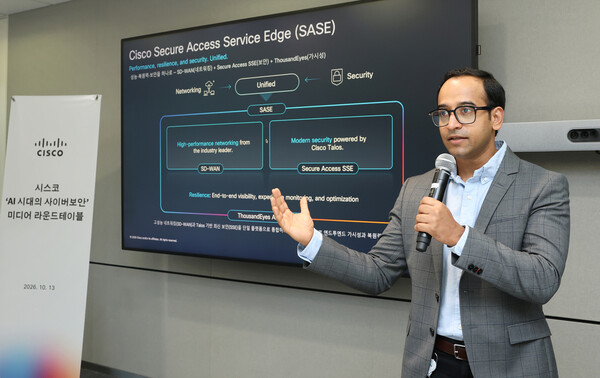
[Digital Today reporter Chi-gyu Hwang] "In the AI agent era, security can respond properly only when network and security are combined into one."
Mukesh Chand Tapriyal (무케시 찬드 탭리얄), Cisco's APJC SASE business leader, shared changing security trends in the AI era at Cisco's "Cybersecurity in the AI Era" media roundtable on Oct. 13. He made clear that Cisco's coverage of both network and security would be a strategic advantage in the AI security landscape.
"Network and security go together. You cannot achieve cloud security goals by taking care of only one," he said. "If you integrate network and security and apply policies in the same way, troubleshooting also becomes easier. In the field, it is not easy to identify whether a problem is due to the network or security, and it also helps in finding the cause," he added.
He said it can also prevent fragmentation of security solutions, leading to efficient management. "AI agents operate on the network, so security and network cannot be separated," he stressed again.
In Cisco's case, it integrated network and security by combining SD-WAN with its cloud security service Secure Access. The company said SD-WAN supports choosing the optimal path and recognising applications to improve quality of service.
Tapriyal said that 10 years ago, traffic moving through networks was predictable and applications were centralised. A private network, or MPLS, was sufficient. The current environment is very different from back then. Users are dispersed and applications have moved to software-as-a-service, or SaaS. Direct internet access from branch offices is now commonplace. For corporate administrators, the burden of inspecting cloud-bound traffic at branch offices has also grown.
With the emergence of AI agents, this burden is growing further.
"Agents change the traffic pattern itself. They access applications wherever they are, whether in the cloud or a data centre, and even for the same task they generate far more traffic than people," Tapriyal said. "Agents, inference traffic and automated workflows are all sensitive to connection quality. The more AI adoption increases, the more connectivity will become a core factor for organisations," he said.
New risks arising from AI are also increasing, including unauthorised "shadow AI", use of unsafe tools and prompt injection.
"Cisco AI Access identifies more than 4,000 AI applications. Based on that, companies can identify shadow AI and prevent data leaks," Tapriyal said. "They can also decide what conversations to allow among users, agents and AI models. They can control AI so it is used only for compliant purposes," he said.
Open-source models are also a management target that Cisco considers important from a security perspective.
"Developers use pre-trained models from places like Hugging Face to boost productivity," Tapriyal said. "Cisco inspects these models before they are used. Before execution, it catches malicious code and checks compliance with intellectual property such as licensing and copyright. It blocks requests coming from unauthorised regions," he explained.
He also explained agents at the meeting by comparing them with humans and machines.
Humans have a broad scope of work but have limits in speed and scale. They have common sense and judgement. Machines such as robots have a narrow scope and can be controlled by rules. But agents are a completely different kind of entity. Tapriyal said, "They have a scope as broad as humans and their scale is exponential, but they have no judgement. They can pose a major risk to companies."
Tapriyal stressed identification and approval as keywords for responding to threats from AI agents.
"We find all agents in the network and identify who owns them and what they do. We also make each action subject to approval. We examine what data they access, where it starts and where it is sent," he said. "You cannot control everything. What you can control is how quickly you respond to change and risk," he said.
Cisco is also stepping up its push into the South Korean market by promoting its network and security integration strategy. As part of strengthening localisation capabilities, it has been operating a Secure Access Korea PoP, or service point, since July. This has enabled companies to use Cisco's security platform without worrying about data leaving South Korea. Tapriyal said, "We have redundancy across multiple regions in Seoul and support reducing latency with the latest protocols. Data is processed 100 percent domestically to comply with relevant laws and regulations," he stressed.
 Chi-gyu Hwang
delight@d-today.co.kr
Chi-gyu Hwang
delight@d-today.co.kr