
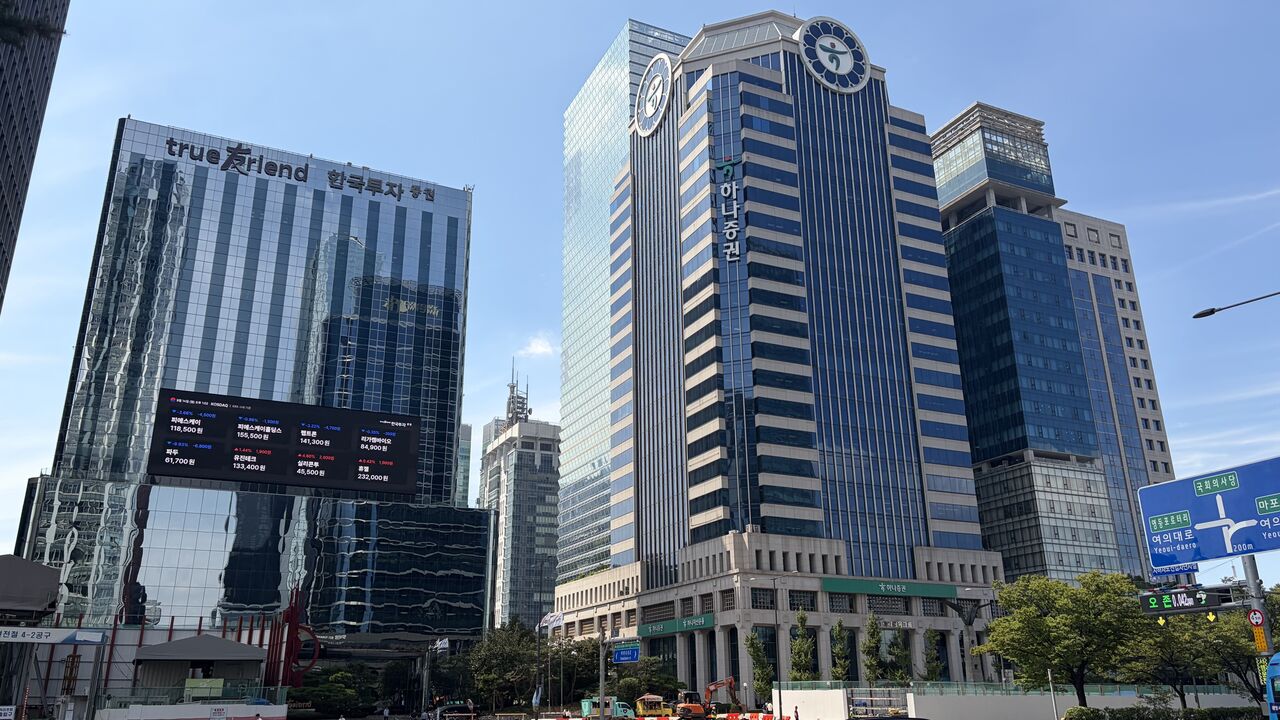
The KOSPI tumbled below 6,000 during intraday trade, and brokerages are divided on the market outlook. Some analysts say it is time to consider bargain hunting, while others call for caution, saying it will take time before a full rebound.
As of 1:25 p.m. on Oct. 13, the KOSPI was down 6.30 percent from the previous session at 5,977.26. The KOSDAQ fell 2.97 percent to 823.99. The KOSPI broke below its 200-day moving average for the first time in two months, adding to concerns about the medium- to long-term trend.
Brokerages cited a combination of factors behind the selloff, including weakening investor sentiment toward U.S. technology shares, news on technological development by a Chinese semiconductor company and geopolitical instability in the Middle East.
The unveiling of next-generation DRAM technology by China’s ChangXin Memory Technologies (CXMT) stoked concerns about the competitiveness of South Korean memory chipmakers. Comments by Broadcom and Intel on funding burdens also added to doubts about the sustainability of artificial intelligence investment.
In the Middle East, worries over higher oil prices stemming from Houthi attacks on a Saudi Arabian airport and Russian military activity weighed on markets. The persistence of elevated long-term U.S. Treasury yields also had a negative impact on sentiment toward growth stocks.
Brokerages place greater emphasis on the view that the decline was amplified by a weakened supply-demand structure in South Korea’s stock market than by overseas negative factors.
Kim Seok-hwan (김석환), an analyst at Mirae Asset Securities, pointed to mounting downward pressure on Samsung Electronics’ share price despite the company posting its best-ever quarterly results. He said new buying was insufficient to absorb foreign selling, even as corporate earnings improved.
He also cited as a burden that share buybacks by Samsung Electronics and SK Hynix are nearing their end. With buyers who had been absorbing foreign selling weakening, stock prices could react more sensitively even to selling of the same size, he said.
Foreign investors net sold more than 2 trillion won of KOSPI stocks in the previous session and continued selling on the day.
Jeong Da-un (정다운), an analyst at LS Securities, also said foreign net selling has been widening price swings as the buying capacity of retail and institutional investors has been limited. He said foreign investors are adjusting their investment decisions in the semiconductor sector, reflecting uncertainty over the sustainability of AI infrastructure investment and monetisation.
Seo Sang-young (서상영), a managing director at Mirae Asset Securities, pointed out that South Korean and Japanese markets plunged while U.S. stocks posted relatively smaller declines. He said large-scale spending plans by U.S. AI data centre companies are weighing on some Asian firms, while China’s advances in semiconductor technology and the possibility of tighter U.S. curbs on China also combined to dampen investor sentiment.
Some, however, say investors should review the possibility of buying on dips after a sharp short-term fall in share prices.
Kim Dae-jun (김대준), an analyst at Korea Investment & Securities, put the 12-month forward price-to-earnings ratio (PER) at 4.6 and the price-to-book ratio (PBR) at 1.17 at the KOSPI 6,000 level. With the 12-month forward PER far below the 10-year average of 10.1, he assessed the market as undervalued in valuation terms.
But he said it is hard to expect a quick rebound based solely on low price levels because a recovery in sentiment and market flows is being delayed. He cited key events that could shape market direction, including U.S. consumer price index data and ASML earnings on Oct. 14, and U.S. producer price index data and TSMC earnings on Oct. 15.
Kim Min-kyu (김민규), an analyst at KB Securities, interpreted the drop as a process of "searching for the second bottom of a W-shaped rebound." He said sentiment toward the semiconductor sector has weakened, but earnings forecasts have not been sharply damaged. He also judged that phased buying could be possible in the mid-5,000s to low-6,000s on the KOSPI.
Jeong also said an approach from the perspective of phased buying is valid in the 5,000 range on the KOSPI. He cited the possibility of stabilising U.S. interest rates and share prices being near prior lows.
Others urged caution, saying even if a short-term rebound emerges, it would be difficult to immediately judge it as a trend reversal.
Han Ji-young (한지영), an analyst at Kiwoom Securities, said intensifying Chinese semiconductor competition, large-scale position adjustments by foreign investors and technical selling pressure from the KOSPI’s break below the 200-day moving average all worked in combination.
He said that while the market has already entered oversold territory, weak sentiment and shrinking turnover mean there are too few buyers to absorb selling.
He said the area around the KOSPI 6,000 level is a zone where investors should watch for the risk of additional declines while also checking whether a short-term bottom is forming.
Key variables for whether a rebound takes hold are foreign flows, U.S. interest rates and the earnings outlook for semiconductors. If foreign selling eases and U.S. inflation data come in in a way that reduces rate-related 부담, sentiment could recover.
Earnings announcements by SK Hynix and Samsung Electronics, scheduled for Oct. 27 and Oct. 29, are also expected to be an important turning point. The market is focusing on whether profit forecasts for the two companies hold up.
 Sangyeop Oh
yub@d-today.co.kr
Sangyeop Oh
yub@d-today.co.kr