
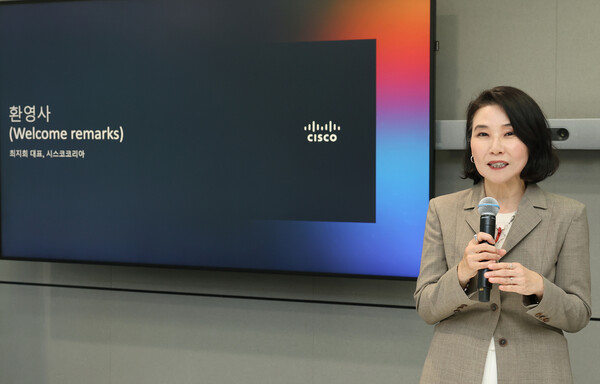
DigitalToday reporter Chi-gyu Hwang - Cisco on Tuesday morning held a press briefing and released the “Relentless Defense Report”, analysing corporate security response capabilities and internal organisational factors that hinder them.
The company said the report contains findings from a survey of 8,000 security professionals in 30 countries. Cisco comprehensively assessed how broadly each organisation protects its overall IT environment, how quickly it detects, responds to and resolves threats, and what factors delay security responses.
The survey showed the global average cyber defence capability score was 64 out of 100, while South Korea recorded 58.
The report pointed to organisational friction as a key factor hampering efforts to strengthen cyber defence capabilities. It said such problems are difficult to resolve through the security team’s efforts alone, because unclear roles and responsibilities, complex approval procedures and departmental silos exist across the organisation, including IT, procurement and senior management.
The survey found more than 8 in 10 security practitioners, including the same share at South Korean companies, said the use of AI improved threat detection and response capabilities by at least 25 percent. More than 1 in 4, while South Korean companies reported 1 in 5, said AI significantly reduced workloads.
However, fewer than half of organisations made broad use of AI-based security functions. AI use was most active in network security but lowest in security operations and investigation. The report said adoption was relatively slow even though security operations and investigation are areas where AI can directly reduce the workload of security teams.
Only one-third of organisations, and one-fifth of South Korean companies, had widely introduced AI agents in security operations. Concerns about data exposure, system breaches and third-party data processing were found to be barriers to adoption.
The report also drew attention by including an analysis of “Relentless Defenders”, a group Cisco classified as having the highest level of security capabilities among organisations worldwide.
In the survey, Relentless Defenders accounted for 8 percent of the total, and only 1 percent in South Korea.
Relentless Defenders were found to be more proactive in reducing organisational friction and managing AI under in-house development. A higher share also said they were achieving better results through AI in security operations.
Among Relentless Defenders, 83 percent shared information and tools across security, network and infrastructure and operated as a single integrated security team. The figure was 37 percent in the remaining group.
Among Relentless Defenders, 86 percent applied consistent security controls to AI agents and non-human identities, compared with 37 percent in the remaining group. Also, 77 percent said they could detect and respond if an AI agent was compromised, compared with 51 percent in the remaining group. Some 25 percent said AI improved threat detection speed by more than 100 percent, compared with 7 percent in the remaining group.
Carl Solder (칼 솔더), chief technology officer for Cisco Australia and New Zealand, said, “The adoption of AI in networks was an inevitable change. It was already difficult years ago for human responses alone to keep up with the speed of threats occurring at the packet level. Networks have therefore evolved to respond to threats in real time. Now security operations have reached the same inflection point.” He said, “Leading organisations do not stop at using AI like a chatbot added separately to the security operations centre (SOC). They are using the network fabric itself as a sensor and policy enforcement engine for the entire security stack.”
 Chi-gyu Hwang
delight@d-today.co.kr
Chi-gyu Hwang
delight@d-today.co.kr