
Siemens Digital Industries Software aims to turn companies’ use of AI into tangible management results. It plans to support corporate AI transformation by connecting data scattered across internal systems and centrally managing AI agents through a new platform called Intelligence Center X.
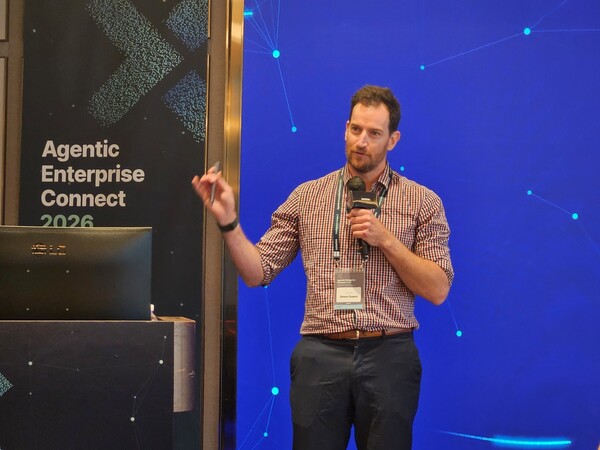
Siemens held a press briefing on Tuesday at Josun Palace in Seoul’s Gangnam district under the banner 'Agentic Enterprise Connect 2026' and introduced its enterprise AI operating strategy and key functions of Intelligence Center X.
Siemens assessed that corporate AI investment is surging but cases that translate into actual management results are limited. Simon Gerin (사이먼 게린), Siemens chief technology officer, said global AI investment this year is expected to reach $2.5 trillion, but only 6 percent of companies have experienced a meaningful improvement in returns. He said many companies have introduced AI into their work, but 74 percent of them have not reached the commercialisation stage.
There was also a gap in the AI impact felt by individuals and organisations. In a survey presented by Siemens, 65 percent of respondents said AI helps their individual work. The share that said it helps improve performance across the organisation was 12 percent.
Gerin cited a lack of context for corporate work, data fragmentation across systems, insufficient mechanisms to coordinate work among AI agents, and a lack of governance as causes of the problem. He said productivity gains are difficult if internal data and business processes are not properly connected even as AI model performance improves.
DATA MANAGEMENT AND EXECUTION FROM CONNECTING DATA...INTEGRATED MANAGEMENT OF AI AGENTS
Siemens’ proposed solution is an 'autonomous enterprise' where people, AI and robotics collaborate. It is not full unmanned operation that excludes people from all tasks, but a model in which AI agents and people share roles within a single workflow.
Intelligence Center X, which supports this, is made up of Graph Studio, which handles data connections, AI Studio, which supports building and running AI agents, and Mendix, which links the work of people and AI.
Graph Studio links data distributed across multiple systems such as product lifecycle management (PLM), enterprise resource planning (ERP) and manufacturing execution systems (MES). It uses knowledge graphs and ontologies to help identify relationships between data and business context.
AI Studio builds and manages various AI models and agents. Mendix connects an agent’s analysed results to actual work processing. If AI suggests a solution, a person in charge reviews and approves it. It also records data usage and work-processing histories so they can be traced.
RESPONDING TO HBM YIELD ANOMALIES IN 6 MINUTES...TARGETING SOUTH KOREAN MANUFACTURING
The briefing also included a demonstration based on an assumed semiconductor manufacturing process. Tom de Groot (톰 데 그루트), a Siemens director, set a scenario in which a yield anomaly occurs at a hypothetical high bandwidth memory (HBM) production facility and introduced how Intelligence Center X responds.
In the demonstration, AI agents analysed data across multiple systems, traced the cause of the anomaly and identified 2,400 related wafers. They then drafted an isolation action plan and delivered it to the person in charge. After the person approved it, the MES immediately reflected the action. De Groot said a series of tasks that could take days under the existing approach was completed in 6 minutes in the demonstration environment. A feature of Intelligence Center X is that AI does not stop at analysing problems but carries out actual work actions.
Siemens plans to supply Intelligence Center X actively to South Korea’s manufacturing sector. It will target industries with complex production processes, including memory and HBM as well as shipbuilding, batteries, automobiles, displays and steel.
On adoption strategy, it recommended selecting AI targets based on factors such as the frequency of tasks, the cost of delays in processing, and the number of systems involved. It said effectiveness can be increased when applied to complex tasks linking multiple systems and organisations rather than simple tasks.
Soo-a Lee (이수아), a vice president at Siemens Korea, stressed that domestic companies should use AI not only for work automation but also as a means to innovate across their overall operating systems.
Lee said AI is becoming a priority even in companies’ IT investment. She said they need to consider not only where to apply AI, but also how to create tangible results such as higher sales, lower costs and improved productivity.
 Jin-ho Lee
jhlee26@d-today.co.kr
Jin-ho Lee
jhlee26@d-today.co.kr