
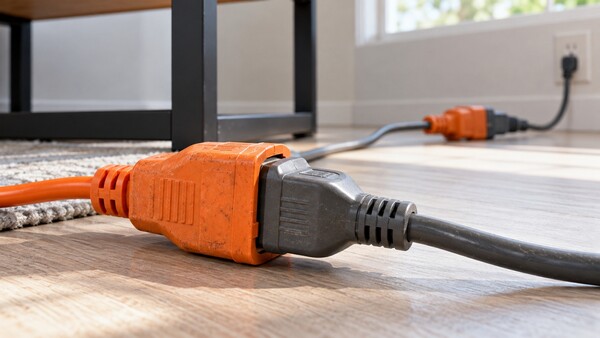
[Digital Today reporter Jae-won Choi (최재원)] A warning has been issued that leaving outlet extension cords used at home or in offices plugged in for long periods can increase the risk of overheating and fire. It pointed out that the habit of using products meant for temporary power connections like fixed wiring can lead to accidents.
Engadget reported on Oct. 12 local time that the Electrical Safety Foundation International (ESFI) warned that continued use of extension cords can, over time, damage insulation or connection points and increase the risk of electric shock and fire.
Simply leaving an extension cord plugged into an outlet with no devices connected does not immediately cause a fire. The problem arises when long-term use leads to cords being pinched by furniture or damaged, or when electrical appliances exceeding the rated capacity are connected.
Article 400.12 of the U.S. National Electrical Code (NEC) stipulates that flexible cords such as extension cords must not be used in place of a building's fixed wiring. It also restricts installation inside walls, floors or ceilings, or routing cords through door gaps.
There is also misunderstanding about usage periods. In the United States, a 90-day limit applies to temporary decorative lighting, but that does not mean it is illegal to use all extension cords for more than 90 days.
In particular, placing extension cords under carpets or furniture should be avoided. That is because heat may not dissipate properly and cords can be compressed or abraded, increasing fire risk. Connecting multiple extension cords in series is also dangerous.
Power consumption of electrical appliances should also be checked. Because allowable current and wire thickness differ by extension cord, the extension cord itself can overheat even if the outlet's circuit breaker operates normally. U.S. fire authorities recommend directly connecting large appliances such as refrigerators and washing machines, as well as portable heating devices, to wall outlets.
In July, a house fire occurred in Loudoun County, Virginia, due to an electrical failure in an extension cord, forcing 5 residents to relocate. The length of time the extension cord had been used and the devices connected to it were not confirmed.
Experts advise checking an extension cord's rated capacity and immediately stopping use if damaged insulation or an overheated plug is found. They say extension cords should be unplugged once temporary use ends, and that adding a fixed outlet is safer if constant power is needed.
 Jae-won Choi
ittt_0801@d-today.co.kr
Jae-won Choi
ittt_0801@d-today.co.kr