
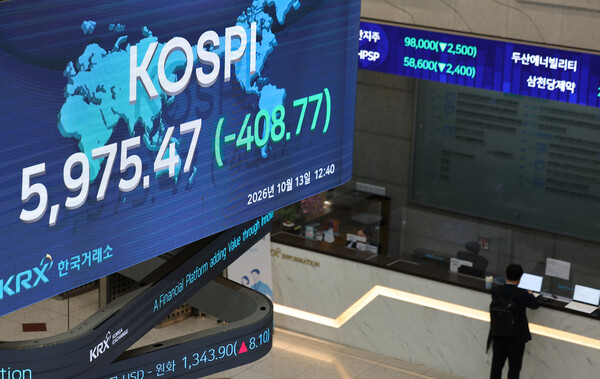
With the KOSPI sliding below 6,000 intraday, the KOSPI 200 Volatility Index (VKOSPI), which reflects investors' fear, surged more than 23 percent. KOSPI market capitalisation also fell below 5,000 trillion won for the first time in about two months.
On the 13th, the KOSPI opened at 6,186.08, down 198.16 points, or 3.10 percent, from the previous session's close, then widened losses as time passed. It broke below 6,000 intraday, dropping back into the 5,000 range for the first time since it regained 6,000 on July 31.
As the index fell sharply, a sell-side sidecar was triggered on the main board at 9:47:58 a.m. It halts the effectiveness of program sell quotes for 5 minutes.
Market volatility also rose sharply. VKOSPI, dubbed Korea's fear index, stood at 50.24, up 23.35 percent from the previous session. The gain is the largest since March 4, when it rose 27.61 percent.
VKOSPI is an indicator that uses KOSPI 200 option prices to show investors' expectations for future market volatility. A sharp rise means market participants see a higher chance of bigger swings in the stock market ahead.
KOSPI market capitalisation also fell below 5,000 trillion won. As of 1 p.m., it was tallied at 4,929 trillion won. If the market closes at the current level, the 5,000 trillion won mark will be broken for the first time in about two and a half months since July 30.
A steep fall in heavyweight semiconductor shares with a large market-cap weighting contributed to the decline. At the same time, Samsung Electronics was down 7.88 percent from the previous session and SK Hynix fell 8.94 percent, extending their declines for a fifth straight session.
The KOSPI's losses have been growing over successive sessions. From the 6th through the previous session, the daily declines were 0.89 percent, 1.98 percent, 2.62 percent and 3.65 percent, respectively. If it ends lower on the day, the KOSPI will fall for a fifth straight session.
Seo Sang-young (서상영), an executive director at Mirae Asset Securities, said "a reassessment of AI investment profitability due to high interest rates and adjustments in global asset allocation are the main reasons for the decline."
Kim Seok-hwan (김석환), an analyst at Mirae Asset Securities, said "for a rebound in stock prices, it will be necessary to confirm changes in foreign investor flows, U.S. long-term rates and the domestic discount rate, and whether next year's semiconductor earnings estimates are maintained or revised upward."
 Sangyeop Oh
yub@d-today.co.kr
Sangyeop Oh
yub@d-today.co.kr