
Kakao is expanding KakaoTalk into a space where users can assign tasks to AI agents and receive results. It aims to connect not only its own agents but also agents created by partners and users so tasks can be requested through conversation.
Kakao CEO Shina Chung (정신아) said in a keynote at the “if(kakao)26” event held on Oct. 13 at the Kakao AI Campus in Yongin, Gyeonggi Province, “We are now creating connections for the next 10 years with AI technology.” She said Kakao will add AI to the connections it has built, linking everything from suggestions to execution for search, shopping and reservations.
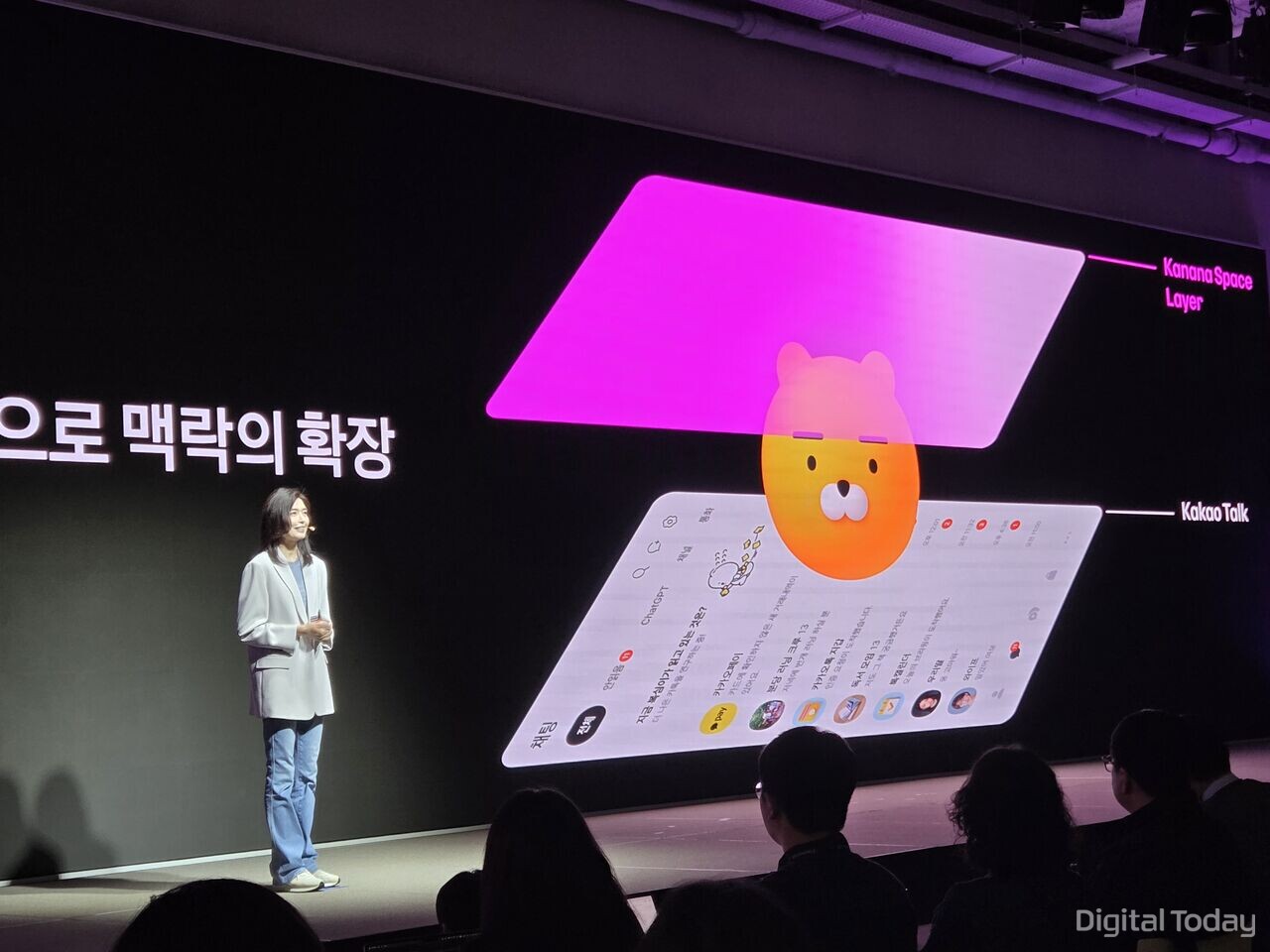
To that end, Kakao unveiled the KakaoTalk-invoked AI assistant “Canana Space” and “Kanvas,” a PC-based service for creating and running agents. It plans to build an “integrated agentic AI interface” around the two services, allowing users to request what they need and use their own agents.
◆Ask by speaking instead of searching menus... Canana Space unveiled
Canana Space is designed so that a Ryan character appears when users swipe the KakaoTalk screen with two fingers. Users can request actions such as sending messages, managing schedules, web searches and changing KakaoTalk settings by voice or text.
Dae-nyeon Kim (김대년), Kakao’s design lead performance leader, said the starting point for the design was making it easy to call AI without disrupting existing KakaoTalk usage flows. Instead of moving to a separate tab or screen, users can get help on top of the screen they are using.
In a demonstration, Kakao showed it filtering unread messages to extract only work-related content, displaying reply deadlines and items to check, and sending a reply in the requested wording to the relevant chat room. It also presented a case where, when asked what a spouse had requested last week, it found and provided information from past chats about a child’s birthday and a request to buy a cake.
Kim said, “What’s important is that it doesn’t end with a simple summary and moves straight to the next action.”
Kakao plans to expand execution to ordering, gifting, reservations and remittances. If a user requests an order for bottled water, it checks previously purchased products and available coupons and prepares the order and payment process. The aim is to have users start work by stating what they want to do rather than searching for needed functions.
Kim said, “Important actions such as sending a message or making a payment are structured so the user directly checks and gives final approval,” adding, “AI helps the necessary process, but the final decision is left to the user.”
Canana Space will begin accepting advance applications from Oct. 13. In December, Kakao will select some applicants for a closed beta test (CBT).
◆An agent team built on PCs... Kanvas to lower barriers to entry
Kanvas is a service that lets users create and run agents on their own PCs. It was prepared to reduce the burden of having to install autonomous agents directly, understand how they work and then set up desired tasks.
When a user decides an agent’s role and the task to assign, Kanvas links the needed tools and skills and builds the functions required for execution. Chung introduced it by saying, “If you install it on my computer, it connects with KakaoTalk, and within familiar conversations you can assign work to a PC agent and receive results.”
Its execution base consists of a core engine that performs tasks, agent-separated browsers and a sandbox environment. It separates environments so agent access information does not mix, and limits impact on other areas of the PC so tasks are performed within the scope allowed by the user.
Chung cited tax filing and year-end tax settlement preparation as use cases. The idea is for an agent to gather scattered materials, enter them on relevant sites, and then proceed through filing and payment after user confirmation. Users can finish the work by confirming key steps rather than managing every procedure themselves.
Kakao plans to run a Kanvas CBT for a small group of users as early as this year. It is also preparing a feature for sharing user-made agents with other people.
◆Linking external agents too... New KakaoTalk space in the first half of next year
Kakao plans to create a new space in KakaoTalk in the first half of next year to connect personal agent teams. It will gradually expand connectivity so users can use not only agents made with Kanvas but also agents developed in other frameworks.
To expand the ecosystem, it will also diversify how partner services participate. Chung said that in the existing integration process, it took time and persuasion to account for partners’ development resource input and revenue structures and to confirm the likelihood of leading to actual traffic and sales.
Chung said, “I realized we need to diversify connection methods so partners can participate more easily and quickly confirm business value.”
In addition to direct service integration, Kakao is also preparing a method in which agents perform tasks in a separate cloud browser. Only the information needed for tasks will be used from among the information permitted by users, and service providers will be able to choose integration methods that fit their own situations.
To provide such experiences to a large number of users, Kakao will also improve operational efficiency for its in-house AI model, “Canana.” Requests that can be handled on smartphones will be processed by an on-device model, while complex tasks will connect to a large model. An “AI conductor” will reduce inference costs by selecting the right model and tools and the execution order for each request.
Chung said, “We plan to connect things so that, from agents provided by Kakao to agents made by partners and even agents made directly by users, they can meet in one familiar interface, talk and assign tasks.”
 Ho-jung Lee
lhj@d-today.co.kr
Ho-jung Lee
lhj@d-today.co.kr