
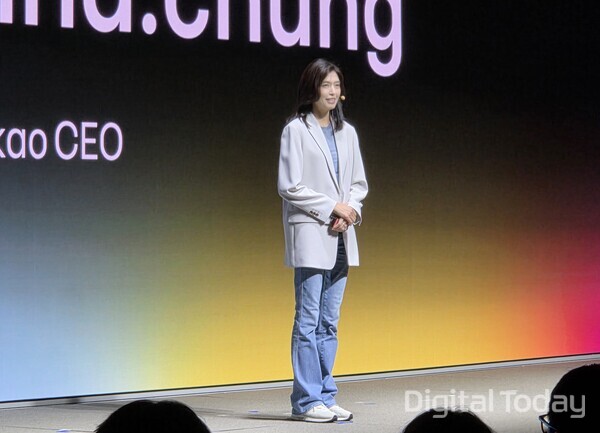
Kakao plans to expand KakaoTalk into an "integrated agentic AI interface". It aims to roll out personalised AI services in stages, centred on the KakaoTalk AI assistant "Kanana Space" and the PC-based agent creation service "Kanvas".
Kakao on Oct. 13 held "if(kakao)26" at the Kakao AI Campus in Yongin, Gyeonggi Province, and unveiled its agentic AI services, in-house AI models, and personalisation and safety technology strategy.
In a keynote address, Kakao CEO Chung Shin-a (정신아) laid out a direction to broaden AI experiences that understand users' preferences and context and carry out actual tasks, centred on KakaoTalk.
AI you can call anywhere on KakaoTalk: 'Kanana Space'
Kakao first unveiled "Kanana Space," an AI assistant that can be summoned at any time in KakaoTalk. Swiping with two fingers on the KakaoTalk screen brings up the Ryan character, and users can request tasks such as sending messages, managing schedules, web searches and changing KakaoTalk settings by voice or text.
Kakao plans to expand Kanana Space's scope of execution to ordering, gifting, reservations and remittances. For example, if a user asks, "Order bottled water," it prepares the steps needed for ordering and payment based on past order history and available coupons.
Kanana Space will conduct a closed beta test in December for some pre-registered users. Pre-registration starts on Oct. 13.
Your own agent team built on a PC: 'Kanvas'
Kakao also unveiled "Kanvas," which lets users create and run AI agents directly on a PC. When users describe the agent they need, Kanvas links relevant tools and skills to set up the execution environment.
Within the scope users allow, agents perform tasks and users confirm at key steps. Users can delegate repetitive or everyday tasks, and Kakao plans to add a feature allowing users to share agents they create with others.
Kakao will run a Kanvas closed beta test for a small number of users as early as later this year. In the first half of next year, it plans to create a space within KakaoTalk to connect users' personal agent teams. It also plans to support the use of agents built on other frameworks in KakaoTalk, as well as agents created with Kanvas.
Kanana model and Mosaic to build a foundation for personalised AI
Kakao also outlined the technical direction for its in-house model "Kanana," which supports its agentic AI services. It presented three core pillars: full-stack optimisation including lightweighting, computation and serving; multimodality that processes text, images and voice; and agentic AI that connects user requests to actual tasks.
It is also preparing a structure in which simple requests are handled by an on-device model on smartphones, while complex tasks are linked to a large model. An "AI conductor" selects the model, tools and execution sequence suited to the user's request to improve computing efficiency.
Kakao also introduced "Kanana-o," an omni language model that understands text, images and voice together and responds by voice. Kakao developed the related encoder and decoder in-house and plans to release them as open source. It also unveiled development progress on "Kanana Live," a full-duplex technology that listens and speaks simultaneously.
For personalisation, it is preparing "Project Mosaic." It links users' memories and experiences as context and enables each agent to receive only the information needed for a task within an allowed scope.
Kakao also plans to further develop data governance and a safety verification system so that agents' action plans and execution processes take place within the scope agreed by users.
Chung said, "On top of connection for everyone, we will add intelligence that understands each individual and works to fit each person's needs, so that anyone can experience AI in familiar daily life."
A total of 55 sessions will be held at this year's if(kakao), covering topics including AI direction, trust and safety, models and agents, and stability and infrastructure.
 Ho-jung Lee
lhj@d-today.co.kr
Ho-jung Lee
lhj@d-today.co.kr