
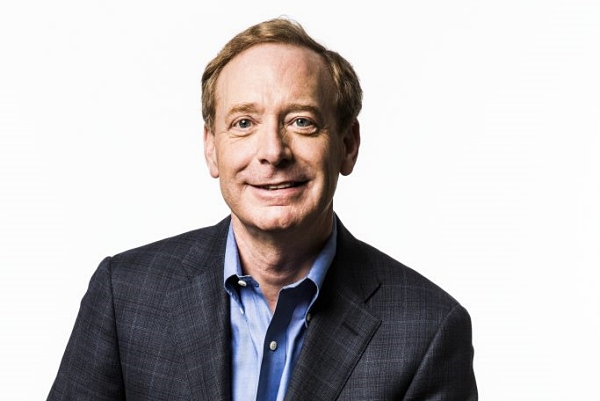
Microsoft President Brad Smith (브래드 스미스) criticised what he called a regulatory vacuum around artificial intelligence.
On Oct. 12, tech outlet Engadget reported Smith said AI carries risks at a level capable of hacking companies and governments, yet faces looser regulation than a carton of milk or a washing machine.
In an interview with ITV, Smith said current safety rules around AI are far too inadequate. "Right now, a washing machine is subject to more safety rules than AI," he said. "Even a carton of milk you see at a supermarket is subject to safety rules and inspections," he said. He raised concerns that given AI's impact on society and the scale of potential harm, current systems fall far short.
The comments came as the U.S. AI industry and the government diverge over the direction of regulation. Major U.S. AI companies such as Anthropic, OpenAI and Google DeepMind have supported measures to slow the pace of AI development. By contrast, U.S. President Donald Trump has shown a stance that the U.S. AI industry should speed up to stay ahead in competition with China.
Trump is placing more weight on corporate self-regulation than on government regulation. At the so-called Super Intelligence summit, Sundar Pichai, Dario Amodei, Mark Zuckerberg, OpenAI President Greg Brockman, Elon Musk and Nvidia CEO Jensen Huang signed an agreement. It included implementing self-regulation, safeguards to prevent leading models from escaping control, and model evaluation by independent auditors.
Criticism of the self-regulation approach also continued. Critics saw it as a problem that companies would decide for themselves what counts as safe. Another critic argued the agreement was no more than a "distraction" and should be ignored. The criticism was that even if the industry sets its own principles, effectiveness could fall short without external oversight and public standards.
Smith said the gap could instead be an opportunity for Britain. He said, "It is a strength that Washington politics in the United States does not view Britain and London the way it views Brussels." He added, "I hope there is a role for companies to play, and I hope Britain, as a country, will play that role." He meant that as the United States does not move quickly on legislation or regulatory arrangements, Britain could expand its presence in talks on international AI norms.
Smith, in particular, linked the risk level of AI models to cybersecurity issues. "When you see models powerful enough to put the world's cybersecurity at risk, I want to say the time to act has come," he said. As a result, the focus of future debate is expected to shift from the pace of AI development itself to which government first institutionalises safety verification and accountability systems, and by what standards.
 Jinju Hong
hongjj@d-today.co.kr
Jinju Hong
hongjj@d-today.co.kr