
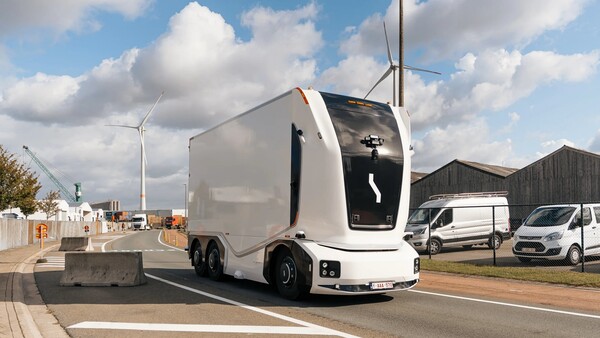
Swedish autonomous technology company Einride has deployed autonomous electric trucks without a driver’s seat for real freight transport in the United States. It is applying autonomous driving technology to routine logistics work beyond test runs, accelerating the commercialisation of unmanned freight transport.
CleanTechnica recently reported that Einride is operating 2 Level 4 (L4) autonomous electric trucks in Marysville, Ohio. The vehicles transport freight daily, shuttling between warehouses operated by logistics company EASE Logistics.
The vehicles are designed with no driver’s seat. They drive themselves without a driver on designated sections, while an external remote operator monitors operations and can intervene when needed.
The route includes not only internal roads at logistics facilities but also nearby public roads. The two companies began actual transport in September and are collecting data such as mileage, freight volume and vehicle operating time. Based on the data, they plan to expand the number of vehicles and operating routes.
The project is part of the Truck Automation Corridor initiative being 추진 by the U.S. states of Ohio and Indiana. The project, which began in 2021, has received a total of $8.8 million (about 11.8 billion won) and aims to verify the safety and efficiency of autonomous driving technology on major freight routes.
A key segment is the 166-mile (about 267 km) stretch of Interstate 70 linking Columbus, Ohio, and Indianapolis, Indiana. However, Einride’s vehicles are operating on a limited section in Marysville, not the full length of the highway.
In March, carrier Nussbaum Transportation deployed 3 trucks equipped with automation technology to the related project.
Work is also under way to build charging infrastructure for electric freight vehicles. Tesla and U.S. truck stop operator Pilot are expanding a Megacharger charging network for the Semi electric truck.
With autonomous driving demonstrations and expansion of charging facilities for large electric trucks proceeding in parallel, attention is also focusing on the shift to electrification and automation in the U.S. freight transport industry.
 Jae-won Choi
ittt_0801@d-today.co.kr
Jae-won Choi
ittt_0801@d-today.co.kr