
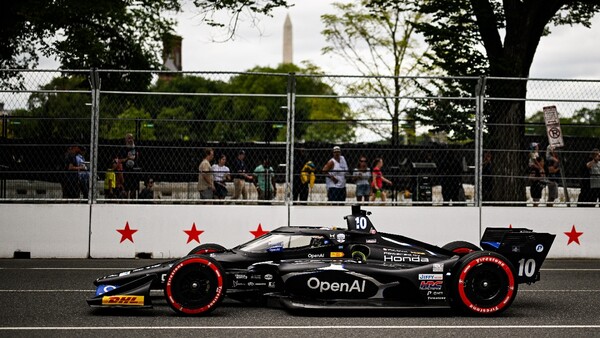
AI is being used in motorsports as a technical tool to boost vehicle performance, beyond serving as a simple sponsor.
On Oct. 7, local time, Ars Technica reported that IndyCar powerhouse Chip Ganassi Racing (CGR) worked with OpenAI researchers this year to optimise car setup. The approach analyses sensor and race data with AI to support engineers' decision-making. OpenAI and CGR are releasing the process as a documentary series.
At the centre of the collaboration is driver Alex Palou (알렉스 팔루). Palou won 6 races and took 8 pole positions in 18 races in the 2026 season to claim his fifth IndyCar title. He has won 5 titles in 6 seasons since 2021 and most recently captured the championship 4 straight years. The extent to which AI contributed to those results has not been disclosed.
The relationship between CGR and OpenAI has expanded from a simple sponsorship into a technical collaboration. OpenAI researchers and engineers are analysing data alongside the team at race venues, and in some races this year Palou's No. 10 Honda competed with an OpenAI-only livery.
AI use is already spreading across motorsports. General Motors (GM) runs systems that analyse radio communications to predict the likelihood of yellow flags during races, and that interpret trackside photos with AI to confirm vehicle damage within seconds. Related analysis is supported by the technology centre in Charlotte, North Carolina.
AI is also used at the vehicle development stage. IBM and Dallara said an AI model trained on computational fluid dynamics, or CFD, data could potentially cut some aerodynamic simulations that used to take hours down to minutes. In Formula One, multiple teams including Racing Bulls are using Neural Concept's AI-based aerodynamic design technology.
In modern motorsports, where massive amounts of data must be interpreted quickly, AI appears to be establishing itself as a new "performance tool" beyond sponsor logos.
 Jae-won Choi
ittt_0801@d-today.co.kr
Jae-won Choi
ittt_0801@d-today.co.kr