
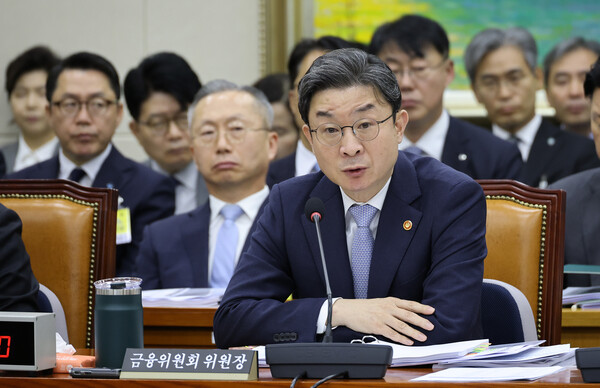
From a string of hacking incidents that hit the financial sector to leveraged single-stock exchange-traded funds (ETFs) and real estate loan regulations, key financial issues were put on the agenda for South Korea's parliamentary audit. Lawmakers focused their questions on financial regulators' security management systems and the effectiveness of policy measures. Delays in institutionalising digital assets and internal controls at state-run banks were also raised as issues.
On Wednesday, the National Assembly's Political Affairs Committee held an audit of the Financial Services Commission, the Korea Development Bank and IBK Industrial Bank of Korea.
Hacking incidents raise need to review financial authorities' checks... Lee says he is "sorry"
Questions were raised about the effectiveness of financial authorities' inspections in connection with hacking incidents that occurred in 7 financial companies in succession.
Kim Hyeong-yeon (김형연), a lawmaker from the Rebuilding Korea Party, said an IP address used in a Shinhan Bank hack had a record of accessing 2 internet-only banks in January. He pointed to a problem that security inspection periods differ by financial company.
Park Min-gyu (박민규), a lawmaker from the Democratic Party, called for improving network separation regulations to introduce AI-based security monitoring. Lee responded, "To block AI, you ultimately have no choice but to use AI."
The FSC has postponed selecting financial companies eligible for a second round of emergency easing of network separation regulations that had been scheduled for Oct. 7.
There was also a clash over whether the presidential office intervened in the process of introducing leveraged single-stock ETFs.
When Park Jun-tae (박준태) of the People Power Party and others pressed Lee on whether there had been instructions from the presidential office, he said that was not the case. He said the commission had heard various views. He also explained that the basis for the introduction was a revision to an enforcement decree, which is under the FSC's jurisdiction.
Kim Hyeon-jeong (김현정), a lawmaker from the Democratic Party, pointed to the possibility that high-frequency trading (HFT) players could disrupt the market and raised the Korea Exchange's responsibility for monitoring.
Lee said he would respond immediately if illegal activity is found. He also said he was "sorry" about investor losses and market confusion.
Debate over effectiveness of mortgage and household loan regulations
Questions also continued over real estate loan regulations. Shin Dong-wook (신동욱) of the People Power Party cited rising Seoul apartment prices and argued that the policy of trying to curb home prices through loan restrictions had failed. Lee said existing regulations had had some effect, while stressing market stabilisation through expanding housing supply.
Han Min-soo (한민수) of the Democratic Party questioned whether the FSC had failed to anticipate end-user demand, noting that it raised this year's household loan growth target to 3 percent from 1.5 percent.
Lee replied that overall volume management was necessary because household debt is very high, adding that changes in circumstances must also be considered.
Jeon Hyeon-hui (전현희) of the Democratic Party criticised banks' business structure centred on mortgage lending and called for expanding financial support that reflects the future growth potential of young startup companies.
State-run banks face criticism over National Growth Fund investment concentration, long-term debt collection
Issues were raised over the National Growth Fund's investment direction and long-term debt collection in the audit of the Korea Development Bank and IBK Industrial Bank of Korea.
Park Min-gyu of the Democratic Party called for strengthening support for AI transformation (AX) for mid-sized and small manufacturers so that National Growth Fund investment does not concentrate on large strategic industries such as semiconductors and AI or on major conglomerates.
Korea Development Bank Chairman Park Sang-gyu (박상규) replied, "It is difficult right now." He added that while investment is currently being made first in semiconductors and AI, he strongly hopes the National Growth Fund will quickly shift to physical AI.
Kim Yong-man (김용만) of the Democratic Party said IBK received 21.5 billion won in dividends and the Korea Development Bank received 8.4 billion won in fees during the long-term debt collection process of private bad bank Sangnoksoo, and raised questions about responsibility.
In response, IBK CEO Jang Min-young (장민영) said he keenly feels responsible. FSC Chairman Lee said the matter is being settled in a direction in which the Saedo-yak Fund purchases Sangnoksoo's bonds.
The audit also included criticism that institutionalising digital assets is lagging, and Lee stated his position.
Lee said the contents have already been prepared for second-stage legislation related to the Digital Assets Basic Act and final coordination is under way. He said he would create a way to move forward safely and firmly without falling behind global trends.
 Lee Ji-young
ljy@d-today.co.kr
Lee Ji-young
ljy@d-today.co.kr