
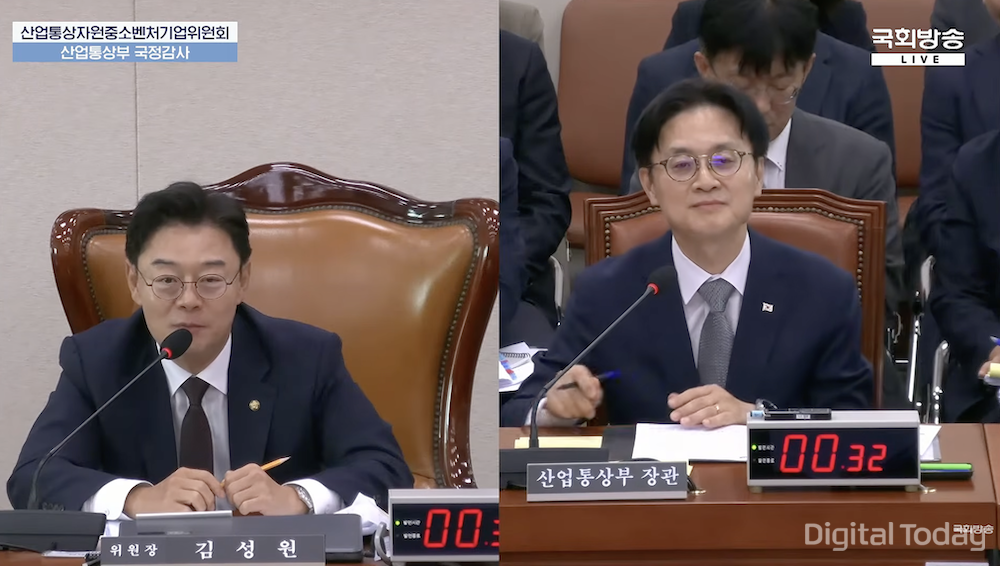
A parliamentary audit of the National Assembly's Trade, Industry, Energy, SMEs and Startups Committee drew attention over major issues such as mega-projects and investment in the United States, but ended up featuring only partisan clashes without substance. The audit proceeded without corporate witnesses and without requested documents, and the Ministry of Trade, Industry and Energy repeatedly responded to questions on industrial issues by saying it would check and review. With key matters handled behind closed doors, there was an assessment that the National Assembly failed to play its role of overseeing the government.
The committee has been conducting this year's parliamentary audit since Oct. 6 on agencies including the Ministry of Trade, Industry and Energy. The government's three mega-projects, strategic investment in the United States and the Alaska liquefied natural gas (LNG) project were also placed on the audit agenda. But preparations faltered from the start over witness attendance. Of the 4 general witnesses adopted, 2 submitted written reasons for absence, and the only witness to attend on the day was Choi Seung-ho (최승호), head of Samsung Electronics' branch of the Samsung Group Super Enterprise Labor Union.
The opposition People Power Party demanded that officials from Samsung Electronics and SK Hynix appear to verify the decision-making process on investment in the Honam semiconductor cluster, but the two companies' officials were not adopted as witnesses. People Power Party lawmaker Seo Ji-young (서지영) said, "We need to reveal whether the companies refused, or who blocked it." Jang Cheol-min (장철민), a floor spokesperson for the Democratic Party, said he had not heard a proposal to summon working-level officials beyond demands for chairmen to attend, and said he would continue talks between floor spokespeople.
Documents demanded by the opposition were also not submitted. People Power Party lawmaker Koo Ja-geun (구자근) said there was no reason not to submit documents on grounds of trade secrets because the projects involve tax money. Seo also said she requested 24 items related to the mega-projects but did not receive 21. Choi Soo-jin (최수진) of the same party said she did not receive a single item of research data on economic feasibility assessments for U.S. investment projects.
In response, Trade, Industry and Energy Minister Kim Jung-kwan (김정관) asked for understanding, saying China, Japan and the United States were paying attention to how South Korea builds semiconductor fabs, making the government sensitive about disclosing materials. Still, with questions continuing without documents, there was an assessment that the audit's function of verifying the government's explanations was weakened.
As proceedings continued without witnesses or documents, similar situations were repeated. Explanations also differed over who first proposed the location of the Honam semiconductor cluster. The Honam semiconductor cluster is a project in which Samsung Electronics and SK Hynix will invest 800 trillion won to build 4 fabs in the area around Gwangju's military air base. The minister replied, "Companies needed production sites, the government proposed it, and the final decision was made by the companies."
But People Power Party lawmaker Cho Ji-yeon (조지연) countered that material submitted by the ministry department to her office on Oct. 1 said companies first conveyed their intention to invest in Honam, and that companies said they had never named a specific region first.
As the situation developed, the ruling party moved to defend the ministry. Democratic Party lawmaker Park Hee-seung (박희승) countered that before the government's announcement, Samsung Electronics' president had asked whether there was a site in places such as Namwon in North Jeolla Province, and said the company made a decision after weighing profits and losses. After committee chair Kim Sung-won (김성원) requested confirmation, the minister only responded that he would check.
◆ Narrowed National Assembly oversight role..."There is no reason to hold a parliamentary audit"
The U.S. and South Korean governments also offered differing explanations over the Alaska LNG project. U.S. President Donald Trump announced that South Korea had decided to invest in the project. The South Korean government explains that the content in a bilateral joint factsheet is the start of a review premised on commercial rationality. Choi said an announcement differed from a closed-door National Assembly briefing on Sept. 22 and called for an audit by the Board of Audit and Inspection.
When the chair asked whether the bilateral agreement and Trump's announcement were the same, the minister said negotiations were under way and asked that the situation be taken into account. Asked about the content of regret expressed to U.S. Commerce Secretary Howard Lutnick, he said he would respond before the end of this year.
The minister's responses on industrial issues also stayed at the level of promising to review. Asked about industrial electricity rates and measures to localise drone and robot parts, he said there was a direction but an answer had not yet been found. When Democratic Party lawmaker Jeon Eun-su (전은수) asked about plans to support semiconductor materials, parts and equipment, the minister said he had not considered which areas would be targeted and said he would differentiate them.
The exchanges led to questions about the National Assembly's oversight role. Seo said there was no reason to hold a parliamentary audit if the committee cannot be given documents. Choi said failing to submit economic analysis materials amounts to denying the National Assembly's budget review authority. Baek said since lawmakers had received a closed-door briefing on grounds of national security, it should be examined whether requested materials were also subject to public submission.
The only issue on which the parties agreed that day was urging an investigation into a leaked transcript of a closed-door briefing on investment in the United States. Jang proposed creating separate National Assembly procedures for briefings as the U.S. investment reports continue. With key details of the mega-projects and U.S. investment handled behind closed doors, it was seen as narrowing the scope for the National Assembly to oversee the government.
The comprehensive audit will be held on Oct. 22. There was an assessment that if floor spokesperson talks on adopting corporate witnesses are not concluded before then, the same clashes could be repeated at the comprehensive audit.
 Seok Dae-geon
d2dg@d-today.co.kr
Seok Dae-geon
d2dg@d-today.co.kr