
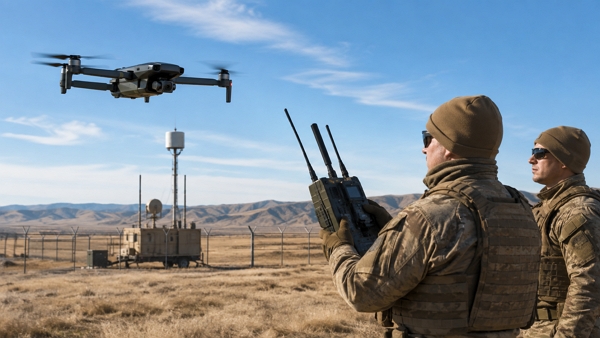
The U.S. Army has succeeded in a live-fire test of a one-time attack drone assembled and operated directly by soldiers. It is a move to secure the capability for frontline units to operate and modify small drones, whose importance has grown in the war in Ukraine, without relying on outside vendors.
TechRadar and other outlets reported on Oct. 7 that the U.S. Army's 2nd Cavalry Regiment conducted live-ammunition strike training on Sept. 30 at the Grafenwoehr training area in Germany using an Orqa MRM2-10 drone. Soldiers assembled the airframe from parts supplied by the manufacturer and added a unit-designed electronic safety device and a 3D-printed explosive housing. The device was nicknamed the "Dragoon bomb" after the unit's moniker.
Capt. Michael Bappe (마이클 배프) said the test had been prepared for more than two years, and described it as the first conventional Army live-ammunition drone strike carried out without support from contractors or outside units. He added it could also be the first for the Army as a whole. This is the unit's account, and it is not a separate record confirmed at the Army level.
In the live-fire test, Sgt. Anjel Calis (안젤 칼리즈) flew the explosive-laden aircraft more than 1 mile, about 1.6 km, to hit the target. It took less than 5 minutes from launch to impact, and a separate reconnaissance drone relayed the strike footage to nearby troops in real time. The unit said a similar system can be operated at distances of more than 3 miles, about 4.8 km, and can be extended to more than 12 miles, about 19.3 km, with additional communications equipment. The test did not verify a 12-mile flight.
The U.S. Army has recently been expanding small drone operations and in-house manufacturing and repair capabilities. The change follows the rapid spread of low-cost drones in the war in Ukraine as tools for reconnaissance and strikes. The Army is also running a trial of a three-week training programme that integrates drone and robotic systems into tactics.
Col. Timothy Price (티머시 프라이스), commander of the 2nd Cavalry Regiment, said the training showed the possibility for soldiers to modify equipment they have and reduce reliance on external support. The Army expects it will be able to provide small units with a means to precisely strike targets at longer ranges than existing individual and squad-level weapons.
 Jae-won Choi
ittt_0801@d-today.co.kr
Jae-won Choi
ittt_0801@d-today.co.kr