
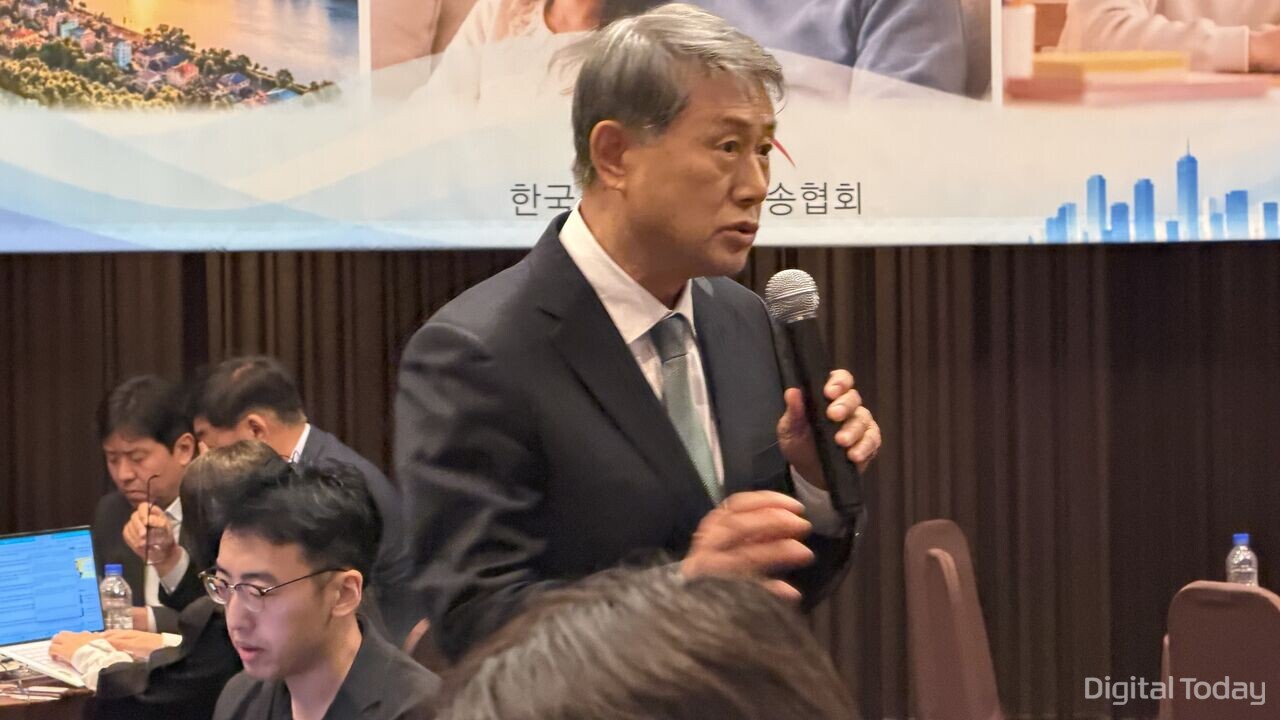
The cable TV industry, facing management difficulties as over-the-top video services (OTT) and internet protocol television (IPTV) grow, is positioning itself as a partner in the government's drive to build a "media basic society". It pledged to strengthen local residents' right to know, expand universal media access and narrow the AI gap, while urging institutional changes to sustain its public role.
Hwang Hee-man (황희만), chairman of the Korea Cable TV Broadcasting Association, said at a cable TV press briefing on putting a "media basic society" into practice at the Seoul Garden Hotel in Mapo-gu, Seoul, on Wednesday that the government says it will create a media basic society. He said cable TV has played that role on the ground in local communities for 30 years. He called for outdated regulations to be reformed so universal media access rights can be protected in a rapidly changing media environment.
Earlier, the Broadcasting and Media Communications Commission presented "a media basic society with the people" as its first-term vision and announced four goals and 12 policy tasks, including universal access, active participation, autonomous choice and a sustainable ecosystem.
In response, the cable TV industry presented three key action tasks centred on localism, universality and AI in line with the government's policy direction, and released an open letter to President Lee Jae-myung.
KEY ACTION TASKS: Strengthening local channels, "Everyone's TV" and AI education
The first task is strengthening local residents' right to know. The cable TV industry plans to continue reporting and recording issues closely tied to residents' lives through local channels, including local news, disaster and safety information, the local economy and small business owners.
The next task is expanding universal media access rights. The industry will integrate 8-level vestigial sideband (8VSB) services, which have operated under different names depending on region and provider, under the shared name "Everyone's TV". 8VSB is a transmission method that allows viewers to watch digital broadcasting without a separate set-top box, and it has been used as a way to maintain broadcasting access for older people and information-vulnerable groups because it is low-cost and easy to use.
The third task is narrowing the AI gap. The industry will support AI use by older people and digitally vulnerable groups through "Our Neighborhood AI Classroom" programmes linked with local welfare centres, senior colleges and community centres. It will also 추진 an AI co-produced programme, "Local AI Sovereignty, Is Our Region Ready?", with participation from local channels of nationwide system operators (SOs), to shed light on AI use conditions among local small and medium-sized companies, traditional markets, universities and rural and fishing communities.
Lee Han-oh (이한오), head of the SO council at the Korea Cable TV Broadcasting Association, said he will ensure the promises made will not end as declarations, and that SOs nationwide will put them into practice in their regions and show the results.
Lee Jae-pil (이재필), chairman of the Korea Cable TV Broadcasting Reporters Association, read out an open letter to President Lee Jae-myung and requested the government's interest and support.
Lee said the group does not want to remain merely a beneficiary of policy. He said it wants to be a local media partner that builds a new regional era of "5 poles and 3 special" and a media basic society together. He asked that the government help ensure work continues to protect local residents' right to know and universal media access rights by working together on the sustainability of cable TV.
The open letter was prepared not to be delivered directly to the presidential office, but to make the industry's position public through the media and urge government attention.
"Media basic society safeguard" - Industry urges regulatory reform for 10 million users
The industry stressed that securing the sustainability of cable TV should come first to realise a media basic society. It said worsening management conditions have reduced room for investment, raising concerns that existing users could be left out of service quality improvements.
Kim Hyuk (김혁), a vice president at SK Broadband, said cable TV serves as a safeguard that protects a media basic society. He said policy attention is needed so that role can continue and improve.
He said he wanted to raise the issue of whether it is acceptable to leave users numbering more than 10 million in this state. He said as the times advance, internet quality, broadcast picture quality and interactive services should also improve, but providers' capacity to invest is shrinking more and more.
As a representative case requiring institutional improvement, the industry raised the issue of levies for the Broadcasting and Communications Development Fund. The Korea Cable TV Broadcasting Association filed an administrative lawsuit on Wednesday against the Korea Broadcasting and Communications Agency to contest the legality of imposing the levy.
According to the association, the levy rate applied to SOs has been kept for more than eight years since it was set at 1.5 percent in 2017. It said operating profit in the SO industry fell to 45.1 billion won last year, sharply worsening business conditions.
The association said such market changes were not reflected in the levy rate. It presented the lawsuit's points of dispute as failure to exercise discretion, violation of the proportionality principle and violation of the equality principle. It also took issue with the fact that while criteria for reductions are 마련 for local terrestrial broadcasting operators, there are no separate reduction criteria for SOs.
Shin Ho-cheol (신호철), head of policy at the Korea Cable TV Broadcasting Association, said the group has repeatedly suggested to the government the need to lower the fund levy, but it has not been reflected. He said it wants a court ruling on the legality of imposing the levy through the lawsuit.
Han Sang-hyuk (한상혁), head of the media business division at the Korea Cable TV Broadcasting Association, said reforms to regulatory policy related to promoting and competition in pay TV are being delayed more than expected. He said he hopes institutional improvements and policy judgments will be made quickly on what position pay TV can settle into in the market to compete.
 Seulgi Son
sageson@d-today.co.kr
Seulgi Son
sageson@d-today.co.kr