
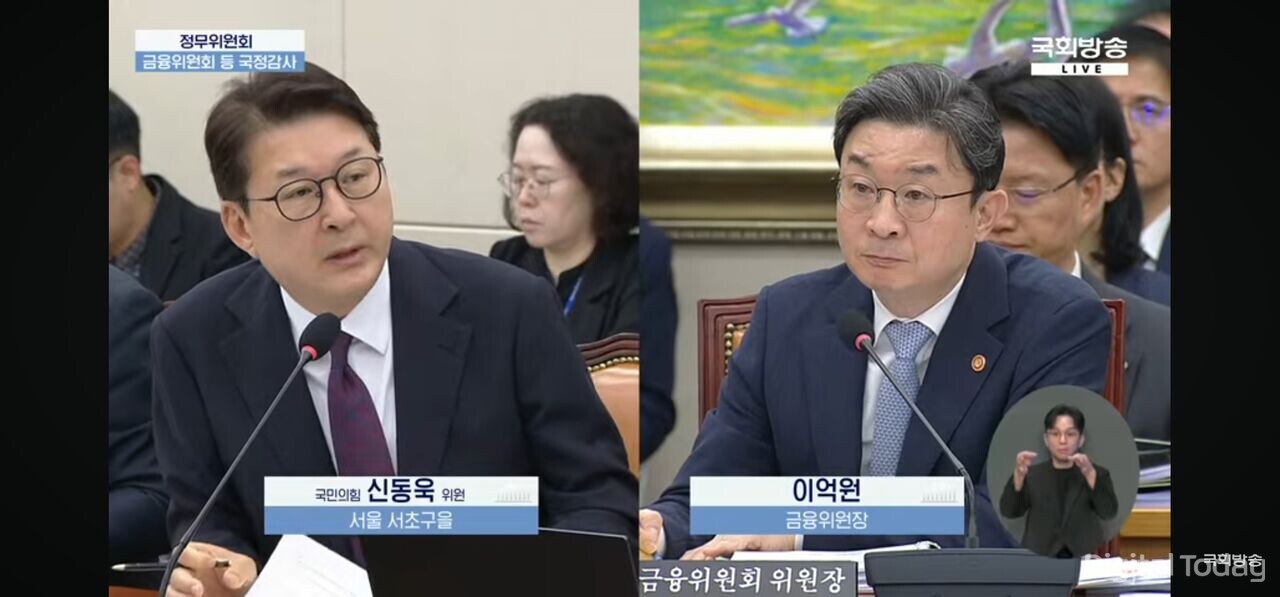
Despite the government’s tough mortgage lending curbs, Seoul apartment prices continue to rise, prompting a clash at a parliamentary audit over the effectiveness of the restrictions. Opposition parties criticised the curbs as creating a home-buying environment that benefits only cash-rich buyers. Financial Services Commission Chairman Lee Eok-won (이억원) said the curbs had some effect and stressed the need to stabilise the market by expanding housing supply.
At the National Assembly’s Political Affairs Committee audit of the Financial Services Commission on Oct. 8, Shin Dong-wook (신동욱), a lawmaker from the ruling People Power Party, criticised the government’s loan policy. He said the average apartment price in Seoul is 1.4 billion to 1.5 billion won, while mortgages are capped at 600 million won for homes priced at 1.5 billion won or less.
Through its June 27 package last year, the government limited mortgages for home purchases in the Seoul metropolitan area and regulated zones to a maximum of 600 million won. In the Oct. 15 package, it applied differentiated caps by home price: 600 million won for homes priced at 1.5 billion won or less, 400 million won for homes priced above 1.5 billion won and up to 2.5 billion won, and 200 million won for homes priced above 2.5 billion won.
Shin said the rules effectively allow only cash-rich people to buy homes. He asked whether prices had fallen as they should have under the government’s calculations.
He also cited 86 straight weeks of gains in Seoul apartment prices and asked whether the policy of trying to curb prices through loan restrictions had failed.
Lee called it a "painful" point, but said prices would probably have been worse if the government had not taken the steps.
◆ "Is a rise in Gangbuk home prices also flattening?" Dispute over expanding supply
A so-called "flattening" in Seoul home prices mentioned by President Lee Jae-myung also came under scrutiny. Shin pointed to a slowdown in gains in high-priced housing areas such as Gangnam, while prices rise in Gangbuk and outer parts of Seoul, and asked whether that could be assessed as market stabilisation.
He asked whether the flattening would continue and whether price increases in Gangbuk or outer areas of Seoul would be seen as inevitable. Lee replied that the market must be stabilised.
After Shin again pointed out that home prices across Seoul are rising even after the loan curbs, Lee emphasised the need to expand housing supply.
Lee said the government is focusing on supply and would stabilise the market by quickly expanding supply further.
Shin criticised the government for belatedly stressing supply expansion after placing more weight on loan curbs.
◆ Responsibility for loan curbs raised; "They were effective at the time"
The audit also raised the question of responsibility for policy officials who led the real estate lending curbs.
Shin mentioned Kwon Dae-young, then a Financial Services Commission vice chairman, who was involved in drawing up last year’s 600 million won mortgage cap, and questioned whether it was appropriate for policy officials to move to key posts while home prices continue to rise.
Lee countered that most assess the 600 million won loan-curb package as having been effective at the time because high-priced homes in areas such as Gangnam were driving the market then.
 Ji-young Lee
ljy@d-today.co.kr
Ji-young Lee
ljy@d-today.co.kr