
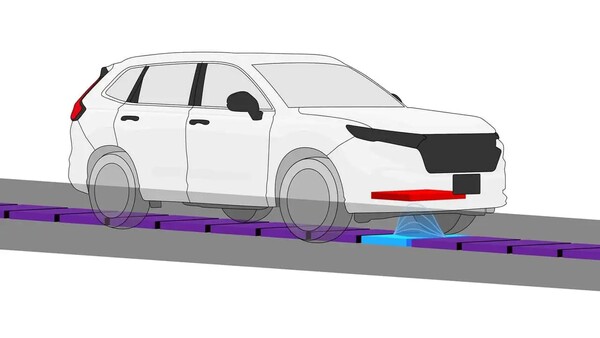
[DigitalToday reporter Jaewon Choi] Honda will conduct a demonstration of dynamic wireless power transfer (DWPT) technology on a Japanese expressway that allows electric vehicles to receive power wirelessly while driving.
On Oct. 6, local time, InsideEVs and Honda reported that a Honda R&D subsidiary, along with Taisei and Taisei Rotec, developed a magnetic coupling wireless power transfer system that sends electricity from transmitters embedded in the road to receivers under vehicles. From fiscal 2027, they will run a public road demonstration on an about 300-metre section near the Kimitsu rest area on the E14 Tateyama Expressway in Chiba.
The key is supplying power while driving without stopping at charging stations. Honda is targeting a peak output of up to 150 kW per ground transmission unit. It plans to verify high-power transfer aimed at future use in large commercial vehicles and stability in high-speed driving conditions. A target was also set for operation at 120 km per hour, the top speed limit level on Japanese expressways.
The initial application targets are trucks and logistics vehicles that require long-distance operation and high utilisation rates. Large commercial vehicles need large batteries to secure long driving ranges, but if they can replenish power while driving, battery capacity and charging waiting times could be reduced.
Taku Ueda (우에다 다쿠), Honda's development chief, explained: "If charging while driving becomes a reality, it could reduce anxiety about charging locations and time and driving range, and it may also reduce the number of battery cells needed for future vehicles." If batteries become smaller, it could also be expected to lower vehicle prices and weight.
Commercialisation would require verification of road excavation and installation costs, durability to withstand repeated passage by large vehicles, electromagnetic field leakage and maintenance costs. Honda plans to first conduct durability tests equivalent to 1 million wheel-load cycles on a separate test road by the end of 2026, then move to an expressway demonstration.
Wireless charging while driving is not a technology Honda is attempting for the first time. Similar demonstrations have been conducted in places such as Detroit in the United States. As a result, a key to future competition is expected to be how much installation costs and economic feasibility can be reduced, rather than the implementation of the technology itself.
 Jaewon Choi
ittt_0801@d-today.co.kr
Jaewon Choi
ittt_0801@d-today.co.kr