
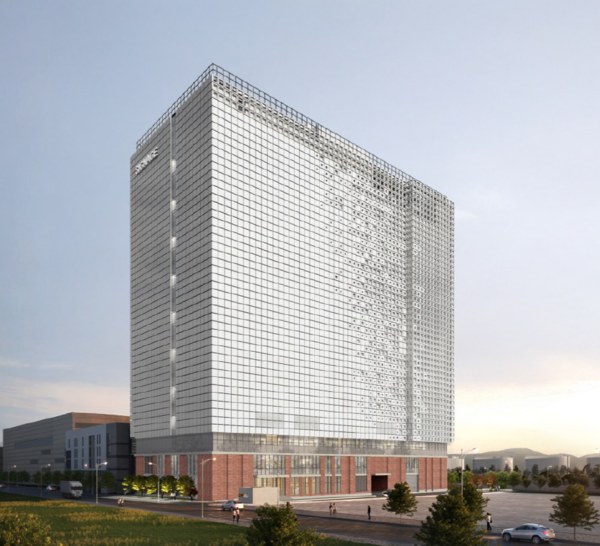
KT Cloud said on Tuesday it will participate as a DBO (Design, Build, Operate) partner in a 50-megawatt AI data centre project to be built in the Cheongna area of Incheon.
The Cheongna AI data centre will span two basement levels and 11 floors above ground, with 50 MW of power-receiving capacity, the company said. Construction is scheduled to start in the fourth quarter of 2026 and finish in the first quarter of 2030.
KT Cloud will be responsible for overall AI data centre development and operations, including design consulting, major MEP works, commissioning for stability and operational validation, and future operations. Hyundai Engineering will serve as a joint contractor, handling architectural, civil engineering, facilities, landscaping and communications works, as well as MEP (mechanical, electrical and plumbing) construction.
KT Cloud said the Cheongna AI data centre is in the western part of the Seoul metropolitan area, within 1 hour of Seoul's main business districts, and is close to Gimpo Airport and Incheon International Airport, offering location conditions preferred by domestic and foreign IT companies.
The Cheongna AI data centre will use a hybrid data hall structure that can accommodate demand for both AI infrastructure and cloud services. KT Cloud said it has separate zones: an AI zone based on D2C (Direct-to-Chip) liquid cooling for running high-density GPU servers, and a cloud zone for general cloud services, enabling flexible responses to diverse customer infrastructure needs.
KT Cloud is expanding its business with the goal of securing AIDC supply capacity of more than 1 gigawatt by 2031 in line with rising demand for AI infrastructure. In the Seoul metropolitan area, it is strengthening its supply base by linking existing data centres with new sites, and outside the capital region it is pursuing large-scale AIDC construction in places including Gunsan to broaden its nationwide infrastructure base.
Kim Bong-kyun (김봉균), chief executive of KT Cloud, said, "We expect the Cheongna AI data centre, as a key hub in the western Seoul metropolitan cluster, will be able to respond effectively to demand from domestic and foreign corporate customers that require large-scale AI infrastructure." He added, "We will continue to expand the AIDC supply base in and outside the Seoul metropolitan area and, based on differentiated technological capabilities, we will make the 1-gigawatt AIDC goal more concrete."
 Chi-gyu Hwang
delight@d-today.co.kr
Chi-gyu Hwang
delight@d-today.co.kr