
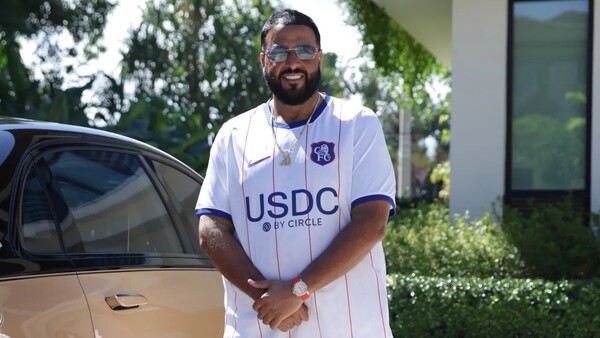
[Digital Today reporter Jinju Hong] Circle posted content that made it look as if rapper DJ Khaled had joined “Team USDC”, prompting continued backlash from the crypto community.
Decrypto, a blockchain media outlet, reported on Oct. 6 that the post did not appear to be an announcement of an official sponsorship or promotional deal. But DJ Khaled’s past history of promoting cryptocurrencies again became the center of controversy.
The controversy began on Oct. 5 when the official USDC account on X, formerly Twitter, posted a photo of DJ Khaled with the phrase “Another one”. In the photo, DJ Khaled was wearing a Chelsea jersey with “USDC by Circle” written across the chest. About 4 hours later, Circle CEO Jeremy Allaire (제러미 알레어) shared the post and wrote, “Welcome to Team USDC.”
There was no mention anywhere in the post of a sponsorship agreement, an ambassador appointment or a payment. Circle is a front-of-shirt sponsor for Chelsea, and DJ Khaled is known as a figure who appeared through a Roc Nation-related promotion Chelsea announced in May. Based on what has been confirmed so far, it means there is no sign that a separate deal has been made official.
Even so, the market reaction was strong. User Joseph Sciarrichi criticized the move on X, saying, “Don’t work with someone involved in this kind of fraud,” and asked whether Circle would let “someone who was fined hundreds of thousands of dollars by the U.S. Securities and Exchange Commission for illegally failing to disclose ICO promotion compensation” represent the brand.
Behind the criticism is the Centra ICO case. DJ Khaled promoted the Centra token along with other celebrities at the time, and paid more than $150,000 in penalties in a settlement with the SEC over not disclosing paid promotion. DJ Khaled was not charged with fraud, and the issue was that he promoted an investment product for compensation without disclosing it.
Reactions from community figures also followed. A crypto investigation account, Wazz Crypto, mocked Circle, asking, “How about sponsoring Kim Kardashian?” It wrote that she is a figure who has strongly supported the use of stablecoins for cross-border payments and fits the brand message well, a satire aimed at past controversy over promoting EthereumMax.
Taylor Monahan, formerly of MetaMask, also reacted strongly. On X, Monahan wrote that Circle was using a promoter associated with a representative ICO fraud case that was reported even by the New York Times and led to investigations by the U.S. Department of Justice and the SEC. Regardless of whether there was a direct deal, the criticism was that Circle itself had put such a figure front and center on the official account and the CEO’s account.
The Centra case dates back to 2017. At the time, DJ Khaled posted a photo of a Centra Tech debit card and promoted the token to his 12.4 million Instagram followers. According to an SEC order, Centra paid DJ Khaled $50,000 for the post, but DJ Khaled did not disclose it.
The project’s core business claims also turned out to be false. Prosecutors said Centra falsely touted partnerships with Visa and Mastercard, and that the CEO introduced as a Harvard Business School graduate, “Michael Edwards,” did not exist. Centra raised more than $25 million, and co-founders Robert Farkas and Sohrab Sharma were each found guilty.
DJ Khaled later settled with the SEC and complied with sanctions. A 2-year restriction barring him from receiving compensation for promoting securities ended in November 2020. Legally, he is in a state with no restrictions on signing contracts again with crypto firms. Still, the case showed that how a stablecoin issuer uses a celebrity can immediately lead to issues of market trust and reputation.
Another one. https://t.co/7EO3AudL8o
 Jinju Hong
hongjj@d-today.co.kr
Jinju Hong
hongjj@d-today.co.kr