
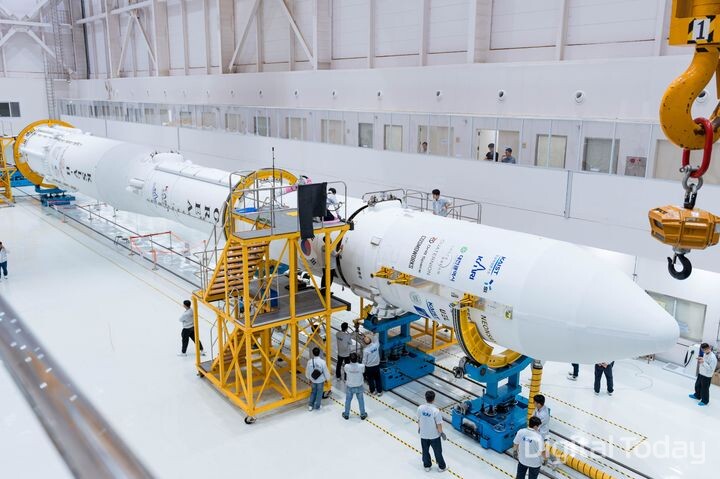
With Nuriho set for its fifth launch, the shift toward private-sector-led space development is accelerating.
South Korea's Nuriho launch vehicle is scheduled to make its fifth launch on Oct. 7 from the Naro Space Center. Nuriho has completed its transfer from the assembly building to the launch pad. The rocket will carry 15 satellites, the most ever, including five NEONSAT microsatellite constellation satellites. NEONSAT is an Earth-observation satellite used to monitor the Korean Peninsula and nearby seas for national security and disaster response.
Unlike previous missions, the launch must separate multiple satellites one by one in the planned order and under specified conditions. It requires the ability to reach the target orbit precisely and to control the rocket's attitude stably. Earlier launches only needed to place a single primary payload into orbit.
The fourth launch was the first in which the private sector oversaw Nuriho production. Up to the third launch, the Korea Aerospace Research Institute led production and launch activities. Hanwha Aerospace said that for the fourth launch it oversaw the entire production process, including management of partner companies and assembly of the fuselage and electrical systems, while the institute handled launch operations. The fourth launch carried the next-generation mid-sized satellite No. 3 and 12 CubeSats. Back-to-back launches from the fourth to the sixth are planned through 2027. It is the first series of consecutive launches in South Korea's launch history.
Hanwha Aerospace's role has grown for the latest launch. Starting with the fifth launch, Hanwha Aerospace has been assembling stages at its Suncheon facility. It plans to increase its participation in launch operations for the fifth and sixth launches and to take on both final assembly and launch operations from the seventh launch. The company previously signed a 24 billion won technology-transfer contract with the institute in July last year. Under the contract, it obtained the full-cycle technology spanning design, production and launch operations, and secured a non-exclusive licence allowing it to directly produce and launch Nuriho through 2032. Technology and experience will be transferred as it jointly conducts consecutive launches with the institute.
The handover of launch operations to the private sector reflects the nature of launch-vehicle technology. Launch-vehicle technology requires repeated launches to build experience in checks and decisions, responses to anomalies and flight data analysis.
During the fourth launch, an abnormality was found in a pressure sensor and the team responded with 1 minute left in the launch window before succeeding. That experience is seen as feeding into the division of control-room responsibilities for the fifth launch. The scope of inspections and responses handled directly by the private sector at the launch site increases with each launch. Hanwha Aerospace explains that a phased transition that allows the private sector time to absorb the institute's development know-how reduces technology gaps and business risks.
The satellites carried on the mission are also tied to securing demand for Nuriho. NEONSAT will be placed in different orbital planes through the fifth and sixth launches, repeatedly observing the same areas at short intervals. The 10 CubeSats flying with it were built by universities, research institutes and companies. Continued launch demand is also needed to maintain the production and supply system of more than 300 domestic companies that participated in Nuriho's development.
Nuriho still faces the task of maintaining the same quality even with repeated production, while reducing launch preparation time and costs. At the time of the technology-transfer contract, Hanwha Aerospace CEO Jae-il Sohn (손재일) said, "We will continue to improve Nuriho's technology and cost competitiveness to lay the foundation for commercial launch services." The assessment is that to move from a research and development project output to an industry, the private sector must build experience in repeated production and launches and secure domestic launch demand.
Seong-ju Kang (강성주), a former senior researcher at the Korea Astronomy and Space Science Institute, said, "This fifth launch is part of the process of transitioning Nuriho to a 'launch system platform that can be used repeatedly.'" He said that going forward, evaluation criteria would focus not only on whether the launch succeeds but also on how accurately satellites are injected, how stably the same rocket can be produced again, and how much experience the private sector accumulates in production and operations. "Such experience must build up to continuously carry out larger space missions such as next-generation launch vehicles and lunar exploration," he added.
 Dae-geon Seok
d2dg@d-today.co.kr
Dae-geon Seok
d2dg@d-today.co.kr