
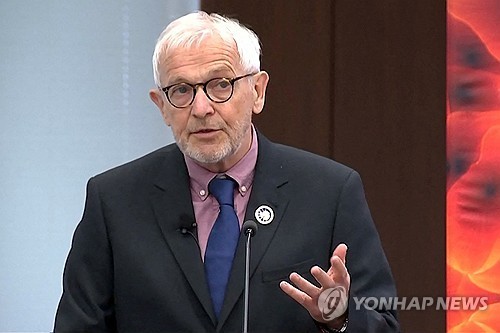
The 2026 Nobel Prize in Physics went to Belgian-born U.S. physicist Francis Halzen (프란시스 할전), who opened a new path in cosmic research through neutrino observations. It is the first time in 34 years that the physics prize has been awarded to a sole laureate.
The Nobel Committee of the Royal Swedish Academy of Sciences said on Monday it selected Halzen as this year’s laureate in recognition of his achievements in making decisive contributions to the IceCube Neutrino Observatory and discovering high-energy neutrinos of astrophysical origin.
Halzen is the lead scientist for the IceCube Neutrino Observatory installed at the Amundsen-Scott South Pole Station in Antarctica. IceCube, which has been operating since 2010, is the world’s largest neutrino detector and uses Antarctic ice.
Neutrinos are particles that hardly interact with other matter, allowing them to travel from deep space to Earth with almost no loss of direction or energy. They are extremely difficult to observe, but successful detection can yield information on cosmic phenomena that is hard to determine with observations based on light or radio waves.
In 1988, Halzen presented the idea of detecting high-energy neutrinos using Antarctic ice. He later led an international research team and spearheaded the construction of IceCube, and the team succeeded in discovering high-energy neutrinos originating from celestial bodies.
The Nobel committee assessed that Halzen’s research provided a new observational tool to identify cosmic phenomena unknown until now.
Mark Pearce (마크 피어스), a member of the Nobel Committee for Physics, said, "Halzen’s perseverance and scientific vision opened the way for a new kind of astronomy."
Halzen is currently a distinguished professor at the University of Wisconsin-Madison and director of its Institute for Elementary Particle Research.
A solo Nobel Prize in Physics has not been awarded in 34 years, since Georges Charpak won in 1992 for inventing the multiwire proportional chamber.
This year’s physics prize money is 12 million Swedish crowns, about 1.61 billion won, and Halzen will receive the full amount.
This year’s Nobel awards announced the physics laureate on Monday after naming the medicine prize winner on Oct. 5. Announcements will follow for chemistry on Oct. 7, literature on Oct. 8, peace on Oct. 9 and economics on Oct. 12.
 Seulgi Son
sageson@d-today.co.kr
Seulgi Son
sageson@d-today.co.kr