
Some companies repeatedly took part in a dataset-building project used to evaluate the government's homegrown AI foundation model project known as Docpamo. The Ministry of Science and ICT acknowledged the duplicate participation but said there were no favoritism or conflict-of-interest issues.
At an audit of the ministry by the National Assembly's Science, ICT, Broadcasting and Communications Committee on Monday, People Power Party lawmaker Kim Jang-gyeom pointed out that similar companies were repeatedly taking part in a government dataset-building project used for the Docpamo evaluation.
Kim said the 2025 knowledge dataset and long-form dataset were effectively the same consortium, with only the lead company changed. He added those firms again took part in building a social safety dataset in 2026.
Ryu Je-myung (류제명), second vice minister at the Ministry of Science and ICT, said it was true that some organisations participated repeatedly as lead and participating institutions in the dataset-building project.
Ryu said the organisations had expertise built from continued participation in the government's data-provision projects. He said duplicate participation was not an issue of favoritism or fairness.
Ryu said the dataset-building process included steps to ensure expertise, such as a prominent mathematics professor at the Korea Advanced Institute of Science and Technology (KAIST) taking part in the case of mathematics problems. He added there were no issues in whether the organisations had conflicts of interest with companies participating in Docpamo.
The audit also included questions about the relationship between the existing Docpamo project and a Frontier AI initiative the government is additionally pursuing.
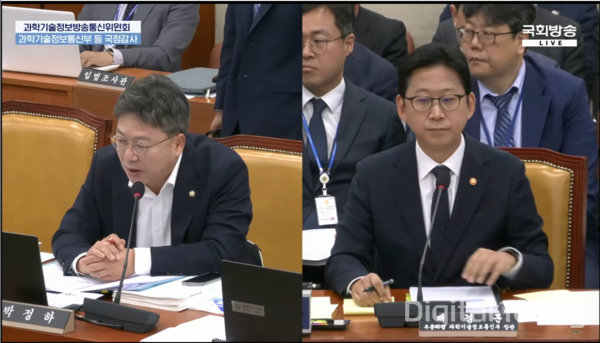
People Power Party lawmaker Park Jeong-ha asked about the differences between the two projects and the background to 추진 them, saying the government had said it would develop a world-leading AI model through Docpamo but the Frontier AI project had recently emerged.
Deputy Prime Minister and Science Minister Bae Kyung-hoon (배경훈) said Docpamo had finished its second evaluation and entered the third stage. He said the third-stage results aim to produce a model close to the level of open-weight models used globally.
Bae said the Docpamo project would continue. He said it would pursue the goal of developing a world-class model while expanding use in existing industries and the public sector and improving AI usability.
On the Frontier AI project, Bae stressed the need to develop a model one step higher than Docpamo.
Bae said Docpamo would proceed as planned, but he believed an additional project was needed through Frontier AI to tackle humanity's previously unsolved challenges and respond to cyber security.
Bae said he judged that AI used in industry and the public sector at the current Docpamo level would find it difficult to reach that level. He added various discussions were under way to secure a Frontier AI model.
 Son Seul-gi
sageson@d-today.co.kr
Son Seul-gi
sageson@d-today.co.kr