
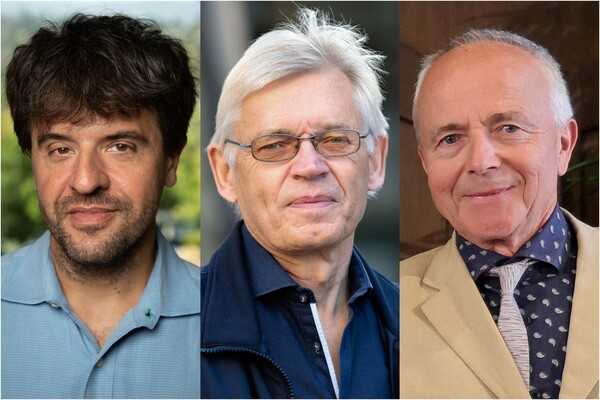
This year’s Nobel Prize in Physiology or Medicine went to three U.S. and German scientists who pioneered optogenetics, a technique that uses light to regulate the activity of specific nerve cells.
The Nobel Assembly at Sweden’s Karolinska Institute said on Oct. 5 local time it had selected Karl Deisseroth (칼 다이서로스), a professor at Stanford University in the United States, Peter Hegemann (페터 헤게만), a professor at Humboldt University of Berlin in Germany, and Georg Nagel (게오르크 나겔), a professor at the University of Wuerzburg in Germany, as joint winners of the 2026 Nobel Prize in Physiology or Medicine.
The committee said the trio was recognized for their "discoveries concerning light-gated ion channels and optogenetics."
Optogenetics is a technique in which light-responsive proteins are expressed in nerve cells and then exposed to light to switch specific cells on or off. It allows precise checks in a living brain of how specific nerve cells affect memory, emotion and behavior, and has become a core research method in modern neuroscience.
The starting point for the research was Hegemann and Nagel identifying the function of channelrhodopsin, a light-responsive protein, in single-celled green algae. In 2003, the two researchers showed that introducing this protein into other cells could generate electrical signals using light.
Deisseroth applied this to neuroscience. In 2005, he demonstrated that applying channelrhodopsin to nerve cells made it possible to control their activity with light, laying the foundation for the development of optogenetics.
Optogenetics has since been widely used to identify causal links between brain circuits and behavior. Research is under way to clarify how brain and neurological disorders work, including schizophrenia, Alzheimer's disease, Parkinson's disease, epilepsy and addiction. Studies also continue to expand the approach to restoring vision in patients with retinitis pigmentosa or to technologies that stimulate auditory nerves more precisely.
The three laureates will share prize money of 12 million Swedish crowns. Following the physiology or medicine prize, this year’s Nobel Prize announcements will continue with physics on Oct. 6, chemistry on Oct. 7, literature on Oct. 8, peace on Oct. 9 and economics on Oct. 12.
 Seulgi Son
sageson@d-today.co.kr
Seulgi Son
sageson@d-today.co.kr