
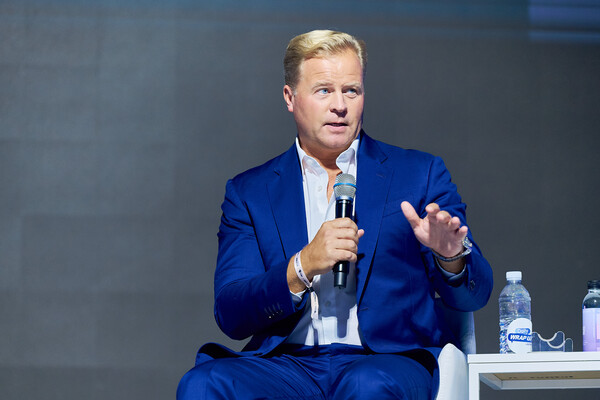
[DigitalToday reporter Sang-yeop Oh] Former U.S. Commodity Futures Trading Commission (CFTC) commissioner Brian Quintenz said digital asset regulation should distinguish between user protection and an approach that blocks risk-taking itself.
Quintenz spoke in a dialogue with Dunamu Chief Brand Impact Officer (CBIO) Sun-joo Yoon (윤선주) at Korea Blockchain Week (KBW2026) held at Grand Walkerhill Seoul in Gwangjin-gu, Seoul, on Sept. 30. "Risk and opportunity are two sides of the same coin," he said. "You cannot gain opportunity, progress and innovation without risk."
He said policymakers should not confuse "customer protection" with "risk prevention" when designing regulation.
He said the goal should not be to block the possibility that investors take risks in the name of protecting customers. Instead, it is important to disclose transparently what risks exist so that people can trade or hedge with that awareness.
Quintenz said, "I think the role of regulators is not to prevent risk, but to create an environment where risk is transparently revealed and can be traded or hedged, and market participants can know that risk."
He also stressed that risk management and user protection are not opposing concepts. Building a market environment where investors can assess and respond to risks is itself one way to protect users.
He said restricting service use or investment choices simply because risk exists could also reduce new opportunities and innovation in the industry.
He also called for consistency in regulation between domestic and foreign operators.
Quintenz said that in some countries there are cases where services by licensed domestic operators are restricted, while similar services by foreign operators that users can access are not subject to the same regulation.
In that case, he said, only operators that comply with domestic rules become less competitive, and demand not met domestically could shift to foreign operators.
He said if a service is allowed domestically, consistent principles should apply to access through foreign operators. Conversely, if a service is defined as illegal, the same rules should be enforced on foreign operators that do business targeting the domestic market.
Quintenz said, "If it is illegal domestically, it should be enforced on offshore operators accessing the domestic market," adding, "Otherwise, it will only disadvantage regulated operators that have worked to comply with the law."
He also stressed that policy leadership at the highest levels of government is needed to change digital asset systems.
He referred to efforts in the United States to pursue legislation on stablecoins and digital asset market structure. He said clear priority-setting at the government level is needed to bring a new industry into the institutional framework and overhaul existing laws.
Quintenz said, "To create new systems, accept innovation and change laws, leadership is needed at the highest political level of government."
He reiterated that the goal of digital asset regulation should not be to eliminate risk itself. He said it should be to disclose risk transparently and enable it to be managed.
He said these principles should also be applied consistently to both domestic and foreign operators to reduce imbalances between regulatory compliance and market competition.
 Sang-yeop Oh
yub@d-today.co.kr
Sang-yeop Oh
yub@d-today.co.kr