
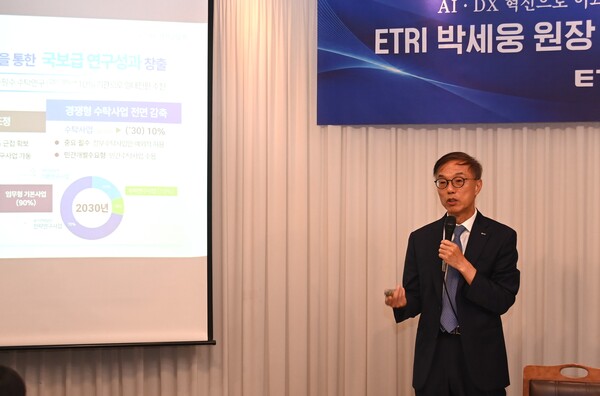
Electronics and Telecommunications Research Institute (ETRI) will use the abolition of the project-based system (PBS) as a turning point to shift its research system from commissioned projects to national mission-oriented research. It will raise the share of mission-oriented research to 90 percent by 2030 and also push to build a third AI computing centre to support AI research.
ETRI President Se-woong Park (박세웅) said at his first press briefing since taking office on Sept. 29, "With the abolition of PBS, we are moving toward an environment better suited to pursuing larger-scale tasks that carry out national missions."
ETRI will expand the share of mission-oriented research projects to 90 percent by 2030 from 22 percent this year. It plans to cut competitive commissioned projects to about 10 percent from 78 percent. Excluding important and essential government-commissioned projects, it will reshape its research portfolio around the institute's own missions and national strategic missions. It also aims to gradually increase government funding for personnel costs to create a structure that focuses on research itself rather than competition to win projects.
It will concentrate research capabilities in five areas: AI, physical AI, three-dimensional communications, spatial media and AI digital transformation (ADX). It will scale back areas with low future growth potential or weak competitiveness. Park cited autonomous driving as a representative case. "I think ETRI can stop doing autonomous driving for cars," he said. "We plan to scale back areas that have no future development potential and are not future-oriented."
In physical AI, it will focus on intelligence technology rather than robot hardware itself. Park mentioned his recent experience visiting Chinese robotics companies. He assessed that China is ahead in mechanical performance, but still has limits in intelligence for interacting with people and objects. ETRI plans to develop AI technology that enables robots to learn and act in industry-specific environments as a differentiated area.
It will also expand computing infrastructure to support AI research. ETRI currently operates AI Computing Center 1 and 2. It plans to pursue a third centre through equipment investment of about 20 billion won. It is also pushing to build infrastructure for shared use of GPUs by linking government support projects with regional research institutes.
This shift in the research system centres on the '4E Combination' strategy. The 4Es stand for Essential, Embracing, Exciting and Excellent. It is a structure that pursues national mission-oriented R&D, building an open research ecosystem, creating a researcher-centred environment and expanding qualitative research outcomes at the same time.
It will also reduce researchers' administrative burden. "The biggest direction is to give time and energy back to researchers," Park said. ETRI plans to foster "borderless players" who conduct research beyond organisational boundaries and support selected researchers so they can use 80 percent of their research time for autonomous, immersive research.
"Rather than competing for leadership among government-funded research institutes, I will focus on building an exchange-based ecosystem in which we support one another," Park said. "I will become a researcher who designs South Korea's future."
He also said, "We must secure unrivalled core technologies in areas the country absolutely needs," adding, "We will make our strengths stronger and boldly take on areas where there are still technological gaps."
 Jin-ho Lee
jhlee26@d-today.co.kr
Jin-ho Lee
jhlee26@d-today.co.kr