
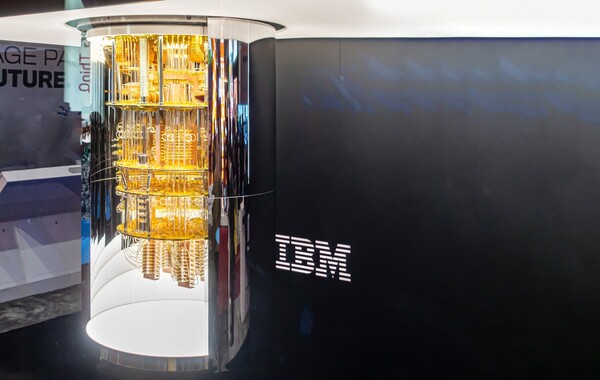
IBM's quantum processor Nighthawk r2 generated 1 million samples in 19 seconds in random circuit sampling, a test used to verify quantum advantage. The same task is estimated to take about 110 years on a state-of-the-art supercomputer, drawing attention to the performance gap using a commercial quantum processor.
On Sept. 30, online media Gigazine reported that a research team led by theoretical condensed matter physicist Tigran Sedrakian (티그란 세드라키안) of U.S. quantum software company BlueQubit released a preprint detailing random circuit sampling experiment results using IBM's Nighthawk r2.
Random circuit sampling runs complex circuits arranged at random on a quantum computer and then collects large volumes of the resulting bit strings. It is used as one of the early benchmarks to check whether quantum computers surpass conventional classical computers on specific calculations.
The team selected 61 qubits on Nighthawk r2 and applied random circuits of up to 40 cycles. The team's calculations estimated that, under those conditions, computing a single output amplitude would require complex-number operations of about 10 to the 22nd power.
The team estimated that collecting 1 million samples using classical methods would take about 110 years even with a state-of-the-art supercomputer.
In contrast, the experiment using the quantum processor took 19 seconds to generate 1 million samples under the 36-cycle condition. The team said it was meaningful that the result came not from specially built research equipment but from an IBM quantum processor that is commercially sold and widely used.
The team claimed the experiment was a case showing quantum advantage using general random circuit sampling. Quantum advantage refers to whether quantum computers can perform computations that are practically difficult for conventional classical computers to carry out in a specific task.
The result should not be expanded to mean that quantum computers are faster than supercomputers for all calculations. The comparison in this experiment is limited to the specific benchmark of random circuit sampling. It does not mean the same performance gap appears in various problems used in industrial settings such as data analysis, optimization and new drug development.
Verification steps also remain. The findings have been released as a preprint that has not yet undergone peer review. The team claimed that most non-expert quantum computer users could reproduce the experiment relatively easily.
That makes it important whether other researchers can reproduce the result under the same conditions, and whether the experimental method and performance comparison are verified during peer review.
The result is assessed as an example showing that the focus of the competition in quantum computer performance is expanding beyond specialized equipment developed in laboratories to commercially available processors that can be accessed in practice. It has technical significance in that it showed a large gap versus existing computing methods in a specific benchmark, but an analysis says the industrial value of quantum computers ultimately depends on whether they can move beyond specific experiments to the stage of solving real problems.
Whether IBM's quantum processor can prove differentiated performance from classical computers on real industrial problems following the experiment is expected to be a key focus for the quantum computing market.
 Jinju Hong
hongjj@d-today.co.kr
Jinju Hong
hongjj@d-today.co.kr