
Dunamu is expanding its business beyond a digital asset exchange into onchain financial infrastructure that financial firms such as banks, brokerages and payment companies can use. It aims to connect its capabilities in trading, custody and regulatory compliance built up in Korea to global markets and develop Korea into a digital finance hub.
Oh Kyung-seok (오경석), chief executive of Dunamu, said at Korea Blockchain Week 2026 (KBW 2026) on Tuesday that blockchain, which emerged by challenging the existing financial order, is now growing into a new infrastructure used by traditional finance. He said Dunamu also aims to leap into new financial infrastructure based on experience and capabilities accumulated through its exchange.
Oh said the boundary between digital assets and traditional finance is rapidly fading in global financial markets.
He cited payment companies such as Visa and Mastercard using stablecoins for payments and settlement, and financial firms such as JPMorgan applying blockchain to real financial infrastructure.
He mentioned that Robinhood is expanding its business from securities into tokenisation and blockchain, and that Coinbase is broadening its scope from digital assets to stocks, derivatives, payments and loans.
"Even if the starting points are different, the destination is the same," Oh said. "The distinction between traditional finance and digital assets is gradually fading, and they are being linked into a single global onchain market."
He said three conditions are needed for Korea to secure competitiveness in the global onchain market: accessibility, connectivity and exportability.
First, he said Korea should build a predictable system and infrastructure so that foreign capital and companies can enter the domestic market. After global capital enters Korea, it should be able to connect to the won and lead to real financial activities such as payments, investment and corporate cash management, he said.
He also stressed the need to expand overseas the market-operating experience and technology accumulated in Korea's digital asset market.
"Korea has operated its market under a high level of discipline," Oh said. "We should make the technology and infrastructure that embody this experience into global standards." He added that regulation would no longer be a cost but would change into financial capability that can be exported.
Dunamu is also expanding Upbit from a retail-focused digital asset trading platform into financial infrastructure that corporations and institutions can use.
Oh highlighted a digital asset custody service that reflects institutions' internal controls and approval procedures. He also pointed to its experience operating exchanges in overseas markets such as Singapore, Indonesia and Thailand while complying with each country's regulations.
He said becoming global financial infrastructure requires services to function under different regulations and varying currency and financial environments across countries.
As corporate and institutional participation expands, it is also expanding related functions beyond trading and custody, including open APIs, staking, custody and onchain tracking. It plans to build payment and settlement functions needed for corporate activities in the future.
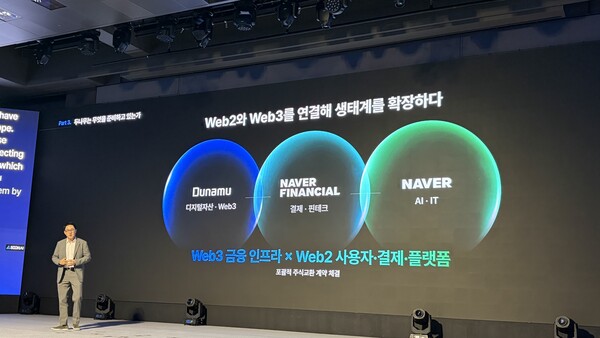
The first linkage Dunamu envisions is combining web3 financial infrastructure with existing web2 platforms.
Oh mentioned the 추진 of a comprehensive stock swap with Naver Financial, saying it could combine Dunamu's digital asset and web3 capabilities with Naver Financial's payment capabilities and Naver's artificial intelligence and IT infrastructure.
"The first linkage is to connect web3 financial infrastructure with web2 user and payment platforms, and through that build financial infrastructure that can compete in the global market," he said.
The second is to connect domestic financial companies to global onchain finance.
Dunamu aims to provide common infrastructure that links individual functions into a single flow, including trading and custody, verification of asset transfers, know-your-customer and anti-money laundering, suspicious transaction detection and blockchain tracking. It aims to enable banks, brokerages, payment companies and fintech firms to build onchain financial services without having to build all systems on their own.
"New York, Hong Kong and Singapore grew into financial centres by connecting the world," Oh said. "I think Korea also has that opportunity in the era of digital finance." He added that Dunamu would turn that possibility into reality as onchain financial infrastructure linking Korea and the world.
 Oh Sang-youp
yub@d-today.co.kr
Oh Sang-youp
yub@d-today.co.kr