
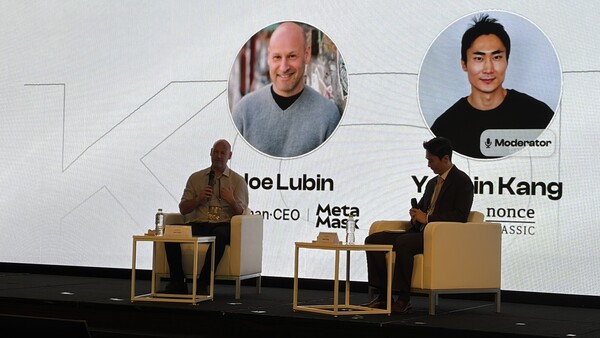
"Blockchain technology is nearing a level where institutions can have confidence. Asset tokenisation and the spread of artificial intelligence (AI) will help blockchain establish itself as core financial infrastructure."
Leading figures in the Ethereum ecosystem assessed the blockchain ecosystem in these terms at the 'Ethereum Korea 1: Genesis' event held at Conrad Seoul in Yeouido, Seoul, on Sept. 28. They stressed that Ethereum's potential as financial infrastructure is growing.
Joseph Lubin (조셉 루빈), an Ethereum co-founder and chairman and chief executive officer (CEO) of MetaMask, said technical maturity and regulatory clarity must be in place together for institutional use of blockchain. He said that, in terms of both the regulatory environment and technical maturity, institutions are nearing a level at which they can understand the technology and gain confidence in it.
He said financial institutions do not need to uniformly choose between public and private blockchains. Each institution can choose a network based on regulation and business objectives, and as technology advances to connect different blockchains, existing boundaries can gradually come down.
Lubin said it is a matter of choice whether institutions use private or public chains. He said that even if they operate on private networks, technology will emerge that can connect them as part of an expanded Ethereum ecosystem.
Tom Lee (톰 리), chairman of the board at BitMine Immersion Technologies, predicted blockchain will greatly change the financial industry's technology infrastructure over the next 10 to 20 years. Lee is also a co-founder and head of research at Fundstrat and concurrently serves as board chairman at BitMine.
Lee said the time has come for financial institutions and the entire banking industry to upgrade their technology architecture. He said he believes finance and AI settlement infrastructure could be built on Ethereum.
He cited asset tokenisation and AI as two pillars that will increase Ethereum usage going forward.
Lee said value that is not currently classified as financial assets, such as reputation or airline points, as well as stocks, bonds and real estate, could be digitised.
He said smart contracts can program rights and trading conditions for such assets, and different forms of assets could emerge in the process than existing financial products.
He said tokenisation will be one of the important trends ahead. He said new value can be created as smart contracts are applied to assets expressed in digital form.
He also pointed to AI agents as a factor that could expand blockchain use. He said that, unlike current AI that operates only when people directly give commands, it may become difficult to manage with existing financial accounts and payment networks if AI agents develop to a stage where they trade or make payments on behalf of users.
Lee said blockchain could be used as the infrastructure to control AI agents' trading terms through smart contracts and make payments. He said one role is to control transactions to ensure AI properly performs what has been requested, and another role is handling money.
He said approaches by South Korean financial institutions to adopting blockchain could vary because different paths are possible depending on each country's regulatory and policy environment.
Lee said South Korea's tokenisation policy appears to be an approach that considers multiple policy objectives, including national sovereignty, taxation and protection of domestic industry. He said this does not necessarily need to be the same as other countries.
 Sang-yeop Oh
yub@d-today.co.kr
Sang-yeop Oh
yub@d-today.co.kr