
The government reaffirmed its position that it will implement taxation on digital assets as scheduled in January 2027. It said it will supplement details through a National Tax Service notice in response to criticism that detailed taxation standards for staking and airdrops are unclear.
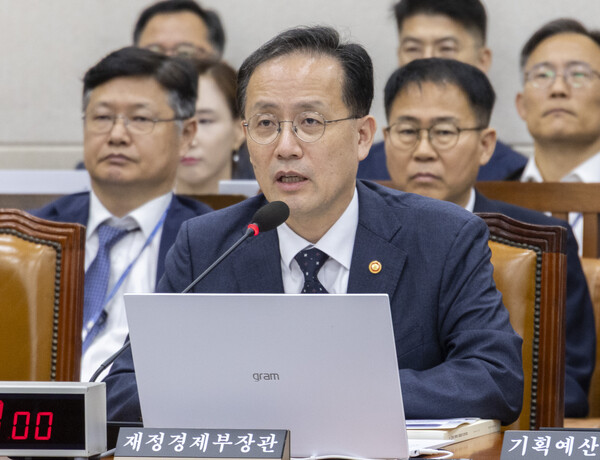
Vice Prime Minister and Minister of Economy and Finance Lee Hyung-il (이형일) answered a question from People Power Party lawmaker Park Soo-young at a plenary session of the National Assembly's Planning and Finance Committee on Sept. 28. Asked whether there was any change to the plan to begin taxation from Jan. 1, 2027, Lee said the current tax law already stipulates taxation from next year.
Under the current Income Tax Act, income from transfers and lending of digital assets will be separately taxed as other income from Jan. 1, 2027. A 2.5 million won basic deduction is applied to annual income, and a combined 22 percent income and local income tax rate is applied to the excess. The taxable base is not the amount held but income generated in the process of transferring or lending.
Park said funds are moving from the domestic digital asset market overseas ahead of the tax implementation. Data he presented showed net inflows of digital assets in South Korea from January to August fell 56.8 percent from a year earlier, while net outflows overseas rose 74 percent.
He argued in effect that the tax rollout should be reconsidered given insufficient preparation for the number of people subject to taxation and the effect on tax revenue.
Lee said holders with less than 5 million won account for about 85 percent of all digital asset holders.
"For holders with less than 5 million won, the basic deduction of 2.5 million won applies, so the tax burden will be almost none or minimal," Lee said. "Even among people in their 20s and 30s, about 90 percent hold less than 5 million won."
Still, the actual tax burden is determined not by the amount held but by income generated from transferring or lending digital assets. The National Tax Service is guiding taxpayers to calculate taxable income by deducting the actual acquisition cost and incidental expenses from the consideration received for transfers and lending.
Lee also said he would consider additional measures if issues arise for investors or during the tax payment process after implementation.
"The tax burden does not appear to be large, but if issues arise in the course of enforcement, we will also look for supplementary measures to secure tax compliance acceptance," he said.
On criticism that taxation standards by transaction type, such as staking and airdrops, are still unclear, Lee said the National Tax Service is preparing a notice in consultation with the ministry. "We will work to have it prepared as quickly as possible," he said.
Digital asset taxation was originally set to start in 2022, but the implementation date was postponed several times due to reasons including the need to improve related systems and tax infrastructure. A 2024 amendment to the Income Tax Act further delayed implementation by two years, and taxation is set to apply to transfers and lending from Jan. 1, 2027.
 Oh Sang-yup
yub@d-today.co.kr
Oh Sang-yup
yub@d-today.co.kr