
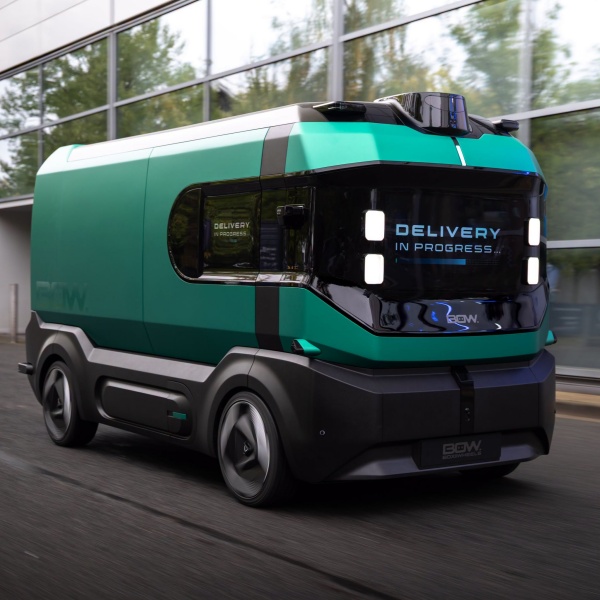
[DigitalToday reporter Jinju Hong (홍진주)] Stellantis has unveiled the BOW, a concept for a self-driving electric delivery vehicle that transports cargo without a driver. It is a new type of commercial vehicle that eliminates the driver seat and cabin and focuses on cargo space. It targets logistics transport in controlled environments such as factories, hospitals and airports, as well as last-mile delivery.
On Sept. 17 (local time), electric-vehicle outlet CleanTechnica reported that Stellantis unveiled the BOW, jointly developed by Stellantis Pro One and autonomous driving and robotics company UQI Robotics.
BOW is short for Box-on-Wheels. As the name suggests, it is shaped like a cargo box set atop four wheels. Unlike a typical delivery van, it has no driver seat or cabin and is designed so that most of the front and interior can be used for moving cargo.
Cameras and various sensors are installed throughout the vehicle, and a large sensor unit is mounted on the roof. This enables an autonomous driving system that recognizes the surrounding environment and allows it to drive without a driver.
The most striking part of the project is that it does not add autonomous driving equipment to an existing commercial vehicle. Stellantis designed the electric commercial vehicle from the outset on the premise that no driver would ride inside.
Existing delivery vans must allocate space for the driver and passengers, leaving part of the interior unusable for hauling cargo. BOW, by contrast, does not need space for a driver, allowing the structure to be designed around cargo. That is why Stellantis has effectively made BOW like a mobile box for freight.
BOW is not a mass-production vehicle intended for commercial production, but a concept car at the development stage. Detailed production specifications such as battery capacity, range per charge, payload, top speed and charging time were not disclosed. Stellantis also did not present a production timeline or sales plan.
As a result, specific performance figures mentioned in some markets are difficult to regard as confirmed information at this stage. It has also not been confirmed whether BOW uses the same battery and motor as existing Stellantis electric vans.
Its intended operating environment also focuses on spaces where it is easier to control operating ranges, rather than all urban roads. Stellantis presented factories, hospitals and airports as key use cases.
In such settings, operating zones can be set in advance and roads and routes can be mapped, reducing the number of variables the autonomous driving system must handle. In contrast, urban roads with many hard-to-predict variables such as pedestrians, bicycles, illegally parked vehicles and roadworks require a higher level of autonomous driving technology.
Last-mile delivery is also an area BOW targets. If a vehicle can move without a driver while transporting cargo from a logistics hub to the final destination, the delivery operating model itself could change. That is because operations could be reorganized around cargo movement and hub operations rather than driver working hours.
But there are still many tasks to solve before autonomous vehicles are deployed in real logistics operations. Beyond simply driving along set routes, the entire logistics operation must be automated, including loading and unloading cargo, handling exceptions and managing safety.
In the project, UQI Robotics is responsible for autonomous driving and robotics technology, and Stellantis combines commercial vehicle development and logistics operations experience. The companies are reviewing the possibility of developing BOW beyond a vehicle for demonstrating autonomous driving technology into a logistics platform that can be used in real commercial environments.
BOW drew attention at IAA Transportation 2026 because it takes a different design approach from existing electric commercial vehicles. While electric vans and electric trucks have focused on electrifying commercial vehicles while keeping the internal combustion structure, BOW started from the premise that if there is no driver, the form of a commercial vehicle should also change.
Ultimately, BOW is less an electric delivery vehicle that will be launched soon than a proof of concept showing how commercial vehicles could change in the autonomous driving era. Attention is focused on how far Stellantis can turn into reality a new logistics vehicle that maximizes cargo space by completely removing the driver area and combines autonomous driving technology with an electric powertrain.
 Jinju Hong
hongjj@d-today.co.kr
Jinju Hong
hongjj@d-today.co.kr