
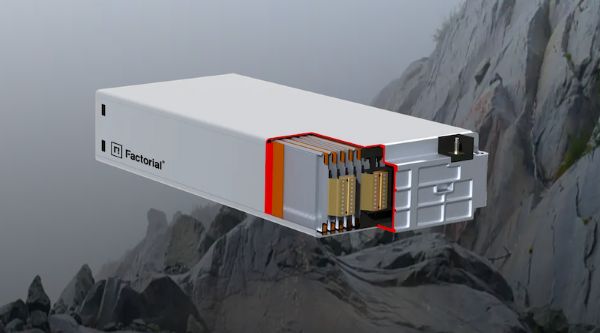
U.S. all-solid-state battery company Factorial Energy is teaming up with Japan’s Mitsui Mining & Smelting to expand commercialisation of sulfide-based all-solid-state batteries using solid electrolytes. The strategy is to combine a supply chain for key materials and mass-production technology for all-solid-state batteries and widen applications to electric vehicles as well as aerospace, defence and robotics.
On Sept. 17 local time, electric vehicle outlet Electrek reported that Factorial Energy will work with Mitsui Mining & Smelting to combine its all-solid-state battery platform, Solstice, with Mitsui Mining & Smelting’s sulfide solid electrolyte technology and pursue expanded mass production.
Factorial has developed solid and semi-solid batteries. It has presented a goal of solving mass production, widely seen as the biggest hurdle to commercialising all-solid-state batteries, by leveraging its FEST technology and the Solstice platform.
Shiyou Huang (시유 황), chief executive officer of Factorial Energy, said the battery is a core technology for realising an electrified society but important technical challenges still remain. He also stressed that battery innovation cannot be achieved by a single company and highlighted a direction of building a foundation that connects the industry as a whole.
Mitsui Mining & Smelting produces sulfide solid electrolytes used in all-solid-state batteries. It developed A-SOLiD, an argyrodite-based sulfide solid electrolyte, and has built a dedicated production facility in Saitama, Japan, to pursue mass production.
Sulfide solid electrolytes are a key material that transfers ions in all-solid-state batteries. Factorial plans to strengthen the supply base of materials needed for the Solstice platform through cooperation with Mitsui Mining & Smelting and lay the groundwork for expanded global mass production.
Factorial has recently accelerated production and business expansion. It has attracted investment from POSCO Future M and IQT, and in January it secured its first commercial order for passenger cars. In July, it also received its first order in the aerospace field, expanding all-solid-state battery applications from electric vehicles to other industries.
Cooperation with automakers is also continuing. Factorial has been developing all-solid-state batteries for electric vehicles with Mercedes-Benz, Stellantis and Hyundai Motor, among others. Early this year it started the first commercial all-solid-state battery programme in the United States in cooperation with Karma Automotive, and in July it signed a memorandum of understanding with SK On and agreed to pursue applying its all-solid-state battery cell technology to SK On’s global production network.
Performance metrics are also being presented as factors supporting commercial viability. Factorial said the Solstice platform can achieve energy density of up to 450 Wh/kg. The company said this is about 80 percent higher than conventional lithium-ion batteries. It also said stability can be maintained in an environment of 90 degrees Celsius.
Vehicle testing has also been conducted. Mercedes-Benz said it drove a modified EQS fitted with 106 all-solid-state cells from Factorial for more than 1,200 km. Stellantis also conducted road tests in North America by applying FEST cells to a Dodge Charger Daytona prototype.
Stellantis has said that Factorial’s 77 Ah FEST cell achieved an energy density of 375 Wh/kg over more than 600 charge and discharge cycles last year. The company presented that the cell can charge from 15 percent to 90 percent in 18 minutes and maintained performance across a temperature range of minus 30 degrees Celsius to 45 degrees Celsius.
In an interview in December last year, Factorial said its all-solid-state EV battery could be applied to electric vehicles as early as 2027. It has been suggested that initial applications are likely to be in high-performance or premium electric vehicles rather than mass-market models.
The cooperation with Mitsui Mining & Smelting is seen as a move to strengthen both materials supply and mass-production processes, key tasks in commercialising all-solid-state batteries. Attention is on whether Factorial can bring forward the timing of actual mass production and application of all-solid-state batteries as it expands cooperation beyond automakers to materials companies.
 Jinju Hong
hongjj@d-today.co.kr
Jinju Hong
hongjj@d-today.co.kr