
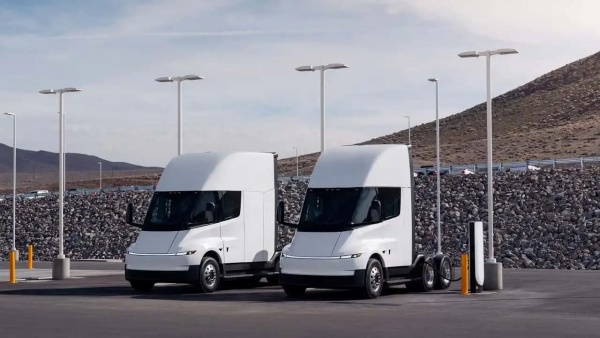
Tesla will initially build more than 100 megawatt-class Megachargers in Europe. The buildout will be timed to Tesla Semi delivery plans in Europe starting next year.
InsideEVs, an electric vehicle outlet, reported on Sept. 17 that the initial deployment will be more than 100 chargers across 21 charging stations. The countries are Germany, France, Britain, Sweden, Belgium, the Netherlands and Luxembourg. Tesla did not disclose a specific completion date for the first phase.
Dan Priestley (댄 프리슬리), Tesla's head of Semi development, presented the first Megacharger installation plan in Europe at this year's IAA Transportation event in Hanover, Germany. Presentation materials listed Germany, France, Britain, Sweden, Belgium, the Netherlands and Luxembourg as the first regions in Europe to introduce Tesla-branded megawatt chargers.
Megachargers are ultra-high-power charging systems designed for heavy electric trucks such as the Semi. Tesla said its Megachargers support up to 1.2 megawatts and can charge the Semi's large battery to 60 percent in about 30 minutes. The European setup consists of a 1,000-volt power cabinet and 2 charging stalls, and can supply up to 1,500 amperes to an electric vehicle.
The network buildout is drawing attention because it ties vehicle launches to infrastructure at the same time. Unlike diesel trucks, heavy electric trucks need high-power charging networks to operate long distances commercially. Tesla appears to be seeking to lower adoption barriers for commercial customers by outlining charging hubs ahead of the Semi's European launch.
Access will be limited. Because both the Semi and Megacharger use the MCS 3.2 connector, other electric trucks in Europe cannot use Tesla Megachargers immediately. Instead, Tesla plans to provide Semi customers with a CCS adapter so they can also charge at CCS2 chargers across Europe.
Tesla is not stopping at building a public Megacharger network and is also responding directly to private demand. It has started selling Megachargers and Basechargers to companies that need their own charging equipment, such as at logistics hubs. Both products are currently available to order, with the first deliveries in Europe set for mid-next year.
Pricing has also been disclosed. A Megacharger package comprising a power cabinet and 2 charging stalls costs 163,000 euros (about 260 million won). An all-in-one 120-kilowatt Basecharger costs 17,000 euros (about 27 million won) and must be ordered in minimum quantities of 2 units.
The Basecharger is aimed at operators that can charge while vehicles are parked for long periods. It integrates the required components into a single housing and supports 120 kilowatts of direct current and 125 kilowatts of alternating current. Tesla explained that the equipment can charge a Semi battery to 80 percent in about 4 hours.
Tesla's commercial vehicle strategy in Europe is expected to develop in a direction that advances vehicle sales together with an expansion of a dedicated charging ecosystem. With Semi deliveries next year, the pace of charging station construction and whether it can secure private demand centered on logistics hubs are emerging as factors that could determine the early spread of the European electric truck market.
 Jinju Hong
hongjj@d-today.co.kr
Jinju Hong
hongjj@d-today.co.kr