
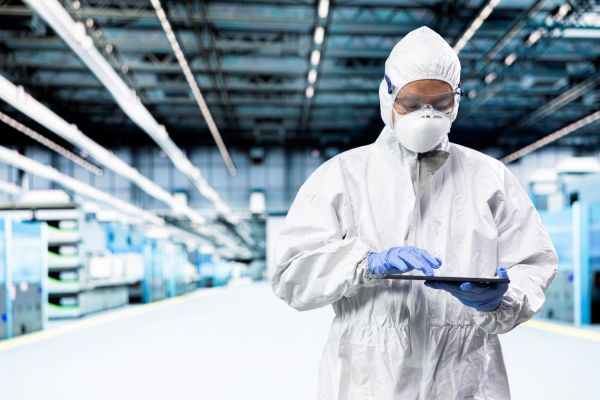
As the U.S. semiconductor industry moves to expand production of artificial intelligence chips, it could face a workforce shortfall of up to 157,000 people by 2030, a forecast showed. The supply of engineers and skilled technicians is failing to keep pace with the speed of factory expansion. Competition to secure talent is also intensifying among major chipmakers including Samsung Electronics, TSMC, Intel and SK hynix.
On Sept. 17, CNBC reported that McKinsey and the SEMI Foundation forecast the U.S. semiconductor industry could face a shortage of up to 157,000 workers by 2030. Only 3 percent of engineering jobholders in the United States enter the semiconductor industry each year, and 73 percent of semiconductor companies are experiencing significant difficulties hiring engineers, the report showed.
Jon Taylor (존 테일러), a senior vice president in Samsung Electronics' semiconductor division, said he was concerned about whether there are enough people in the skilled workforce pipeline. Samsung Electronics is hiring engineers, technicians and supply-chain personnel, but said securing workers has become a race against time as semiconductor manufacturing facilities come online one after another.
The United States is rapidly expanding production capacity for the memory and logic semiconductors needed to run AI. TSMC and Intel are producing advanced logic chips at new fabs in Arizona, and Samsung Electronics is set to start producing advanced logic semiconductors at a new fab in Taylor, Texas, by the end of this year. Samsung Electronics is investing $35 billion, or about 48.36 trillion won, in Texas. Two new fabs under construction in Taylor are expected to create more than 3,500 direct manufacturing jobs.
The United States leads in semiconductor technology and design, but advanced semiconductor production has been concentrated in Asia for decades. As a result, the talent pipeline is relatively strong in Asia, including South Korea. Micron, based in Idaho, is seeking to secure talent by visiting South Korean technical colleges, interviewing students and offering full-time jobs on the spot.
Demand for workers is also rising in memory. Micron is building the first advanced memory fab in the United States in Boise, Idaho, and is also constructing an additional facility in Clay, New York. SK hynix is building its first U.S. facility, worth $4 billion, or about 5.53 trillion won, at Purdue Research Park in West Lafayette, Indiana. The facility will handle packaging rather than full memory front-end production.
As SK hynix and Micron expand U.S. memory production capacity, the likelihood is also rising that they will compete over a limited pool of workers.
Samsung, SK hynix deploy Korean staff; U.S. universities also train talent
Samsung Electronics and SK hynix are temporarily deploying Korean staff for the initial operations of new U.S. facilities. Samsung Electronics sent U.S. employees to South Korea for several months of on-site training, and TSMC used a similar approach when it built its first fab in Arizona.
There are also limits to using foreign workers. Skilled semiconductor workers are concentrated overseas, but bringing in foreign workers through H-1B visas carries heavy cost and procedural burdens. Semiconductor companies are aiming over the long term to build their own domestic talent pipelines in the United States.
U.S. universities have also moved to train semiconductor workers. Purdue University launched a semiconductor-related degree program in 2022, and about 2,500 students take related classes each semester. At Purdue's Birck Nanotechnology Center, students are trained using equipment similar to what is used in actual semiconductor production facilities.
Arizona State University converted a former Motorola fab into a cleanroom training facility. With $200 million, or about 280 billion won, in support from semiconductor equipment maker Applied Materials, it also set up a new center, and TSMC is running a technician training program at Arizona State University. TSMC visited about 12 universities last year and plans to secure about 6,000 workers needed for its first three Arizona fabs by hiring a significant share of several hundred interns.
Intel started an apprenticeship program in Arizona in 2024 and decided to provide $50 million, or about 69 billion won, in scholarships to more than 80 educational institutions near its Ohio fab. In 2025, it also introduced a semiconductor education program starting from the elementary, middle and high school levels. Samsung Electronics has also been supporting semiconductor workforce development programs since 2023 by providing several million dollars to the University of Texas, Texas A&M University and the University of Illinois, among others.
Federal support is also continuing. After the CHIPS Act passed in 2022, more than 80 community colleges created or expanded semiconductor education programs. The U.S. government also set up a $200 million federal fund to develop the domestic semiconductor workforce.
Investment in U.S. semiconductor production facilities is rising rapidly, but a shortage of workers to run them could constrain production expansion. Mitch Daniels (미첼 대니얼스), interim president of Purdue University, said, "If we do not move faster and more aggressively, we will fall behind," stressing the need to speed up workforce development.
 Seung-a Yoo
ysah@d-today.co.kr
Seung-a Yoo
ysah@d-today.co.kr