
[DigitalToday reporter Dae-geon Seok (석대건)] This Chuseok holiday, homebound traffic is expected to be spread out over several days, while return traffic is seen concentrating on a single day. Tmap Mobility said on the 17th it had released daily and time-slot forecasts for travel times between Seoul and major destinations such as Gwangju, Busan, Daejeon and Gangneung, based on past holiday travel data.
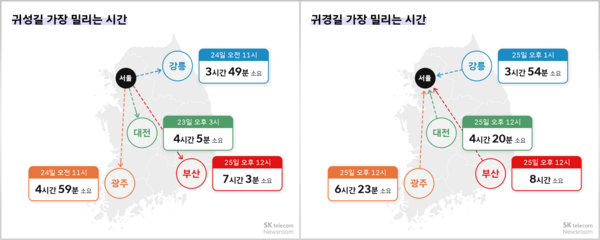
This year’s Chuseok holiday runs for 4 days from Sept. 24 to 27, with the peak congestion day differing by route. On Sept. 23, the day before the holiday, the Seoul-Daejeon route is expected to be the most crowded, taking 4 hours 5 minutes for a 3 p.m. departure. On Sept. 24, Seoul-Gwangju and Seoul-Gangneung are expected to hit peak congestion. Departing at 11 a.m., Seoul-Gwangju is forecast at 4 hours 59 minutes and Seoul-Gangneung at 3 hours 49 minutes.
On Sept. 25, Chuseok day, the Seoul-Busan route is expected to take the longest among homebound trips. A noon departure is forecast at 7 hours 3 minutes, about 2 hours longer than usual. To avoid congestion, leaving late at night on Sept. 23 or in the early hours of Sept. 24 is advantageous. After 7 p.m. on Sept. 24 and after 5 p.m. on Sept. 25, all routes are expected to show traffic flow similar to normal.
Return-trip congestion is expected to concentrate on Sept. 25. Congestion is forecast to start rising from 8 a.m., peak around noon and continue into the night. For a noon departure that day, Busan-Seoul is expected to take 8 hours, Gwangju-Seoul 6 hours 23 minutes and Daejeon-Seoul 4 hours 20 minutes, while Gangneung-Seoul is forecast at 3 hours 54 minutes for a 1 p.m. departure. Busan-Seoul is expected to take about 2 hours 30 minutes longer than usual, marking the longest travel time among routes during the holiday.
Reverse return traffic from Seoul to provincial areas is also expected to be heaviest on Sept. 25. For a noon departure, Seoul-Busan is expected to take 7 hours 3 minutes, Seoul-Gwangju 4 hours 35 minutes and Seoul-Daejeon 3 hours 30 minutes. On Sept. 26, return-trip travel times are expected to be about 1 to 2 hours shorter than the peak congestion time slot on Sept. 25. On Sept. 27, the final day of the holiday, most routes are expected to return to normal levels, except for some congestion on parts of the Busan-Seoul route.
Tmap Mobility plans to support holiday travel with real-time traffic information and convenience services. When a vehicle enters a rest-stop area, a map of rest-stop facilities is automatically displayed on screen, allowing users to check the locations of gas stations, restrooms and nursing rooms, recommended driving routes and information on signature menu items. The service is currently available at 100 rest stops in areas including Seoul, Gyeonggi and Gangwon, and is set to expand in stages.
While driving, the name of the rest area ahead and the remaining distance, as well as the number of fast and slow chargers available in real time at each rest stop, can also be checked on Android Auto and Apple CarPlay. The company said it also plans to provide information on expressway toll waivers, newly opened roads, sections where bus-only lanes are in operation, temporary permission for shoulder driving, and improved images of complex intersections.
 Dae-geon Seok
d2dg@d-today.co.kr
Dae-geon Seok
d2dg@d-today.co.kr