
Demand is growing for high-performance system-on-chip processors for domain controllers that handle autonomous driving and driver assistance as well as cockpit functions. The shift is accelerating from function-specific electronic control units, or ECUs, to domain controllers and central computers. That has increased the amount of computing a single chip must handle.
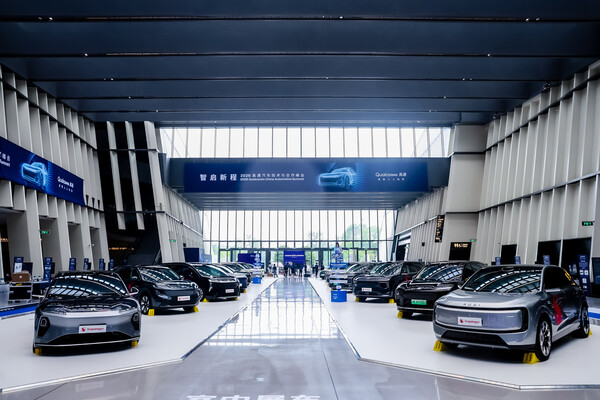
Industry sources said on Sept. 17 that products processing driver assistance and cockpit functions on one chip are being installed in mass-produced vehicles. At the '2026 Qualcomm Automotive Technology & Collaboration Summit' held in Wuxi, China, on June 4-5, more than 70 in-vehicle electronics suppliers held live demonstrations and test drives. Qualcomm introduced practical application results for integrated cockpit and driving functions, along with AI agents, multimodal interaction and advanced ADAS. Snapdragon Ride Flex is now in mass production, and 9 vehicle models have decided to use the chip.
Previously, ECUs handled computing inside the vehicle. An ECU is a device that controls automotive components using a microcomputer. Automakers have used a structure that assigns one ECU to each function, such as the engine, brakes and air conditioning. But as driver assistance expanded from highways to regular roads, the computing burden increased. Monitoring 360 degrees around the vehicle requires handling up to 30 cameras, radars and lidars at once, which has become difficult for ECUs scattered by function.
The solution automakers found is to group related functions and assign them to a single domain controller. Tesla and emerging Chinese automakers introduced it first in large, premium electric vehicles. According to Yano Research Institute, the number of new vehicles using such a centralised structure is expected to reach 21.74 million units in 2028, about 6 times the 2024 level. As the number of controllers falls, the SoC in each controller must handle multiple controls simultaneously.
As demand has grown for SoCs that handle multiple controls at the same time, Nvidia and Qualcomm have entered the automotive chip market long guarded by Renesas and NXP.
Qualcomm has installed Snapdragon Ride Flex, which runs cockpit and ADAS on one chip, in mass-produced vehicles. The Arcfox V9 displayed at a Qualcomm event in Wuxi, China, in June uses a single chip to support memory parking and urban NOA while also running the instrument cluster and HUD screens. Anshuman Saxena (안슈만 삭세나), Qualcomm's senior vice president and general manager for ADAS and robotics, said, "A central computing structure centred on a single general-purpose SoC is already becoming established."
Nvidia started from the other side, autonomous driving. It released Drive Hyperion, a reference platform that pre-matches a configuration of 2 Thor SoCs with cameras, radars and lidars, enabling automakers to reuse the same structure across multiple models. In March, it said BYD, Geely and Nissan are developing Level 4 (L4) vehicles using the platform. It also announced a plan with Uber to deploy robotaxis in 28 cities by 2028. Jensen Huang (젠슨 황), Nvidia's chief executive, said, "Everything that moves will eventually be autonomous."
Chipmakers' automotive revenue is also rising step by step along with this trend. Nvidia's automotive revenue for fiscal 2026 rose 39 percent from a year earlier to a new high, and grew 6 percent in the fourth quarter from the same quarter a year earlier. Nvidia explained that it was the result of continued adoption of its autonomous driving platform.
There are also new entrants. MediaTek said in June it signed a multi-year contract to supply its Dimensity AX C-X1 cockpit SoC, which combines Nvidia GPU technology, to premium vehicle solutions from Foxtron, a Foxconn affiliate. Yole Group forecast that the ADAS and infotainment processor market will grow to $16.4 billion by 2029.
SoC centralised new vehicles seen at 21.74 million units in 2028
For domestic Tier 1 companies that have taken chips and made them into controllers, choosing which chipmaker to partner with and how to work together has become an issue that sets business direction.
Hyundai Mobis chose to co-develop with Qualcomm. The two companies signed a broad memorandum of understanding in January at the CES 2026 Hyundai Mobis booth to jointly develop ride and parking solutions based on Ride Flex. Hyundai Mobis will handle system integration and sensor fusion and perception technology, while Qualcomm will handle SoC technology. Their cooperation is planned through the next stage after driver assistance. They also plan to jointly develop a next-generation SDV integrated solution that combines Hyundai Mobis' standardised software platform with Qualcomm's automotive technology.
Telechips is responding by directly designing chips. It is a fabless company specialising in automotive semiconductor design without factories. It designs and supplies Dolphin5, an application processor for in-vehicle infotainment (IVI) and ADAS. Dolphin5 includes an NPU responsible for AI computing. When Telechips sets the chip's computing architecture, software companies follow that structure. Nota, an AI model compression company, signed a contract with Telechips to optimise a facial recognition AI model for Dolphin5's NPU architecture.
Design capability is also feeding into revenue. SoC development service revenue that began coming in from the fourth quarter of last year became a turning point for a performance rebound. In the second quarter this year, service revenue fell, but sales of existing products such as IVI rose, delivering a third straight quarter of operating profit. Second-quarter revenue rose 33.6 percent from a year earlier.
An industry official said, "As one SoC takes on the role of multiple controllers, the remaining variable is whether companies that take foreign chips and integrate them into controllers, and companies that design chips directly, can carry their plans through to actual orders and mass production."
 Dae-geon Seok
d2dg@d-today.co.kr
Dae-geon Seok
d2dg@d-today.co.kr