
As a full-scale rollout of autonomous driving approaches, competition is intensifying among manufacturers, platform companies and software groups. With vehicle platforms and AI models tied into common standards, having technology alone is no longer enough to stand out. That has made it important to determine which group can accumulate more real-world driving data and connect it to a virtuous cycle of learning, verification and deployment.
Hyundai Motor Group currently holds the broadest set of road data. Vehicles sold in more than 190 countries, totaling more than 7 million a year, can serve as a data-collection network. But that network only becomes practically useful once cars equipped with autonomous driving functions are on the road. Hana Securities said Hyundai Motor Group is now at the stage of gathering difficult driving scenarios with about 40 dedicated collection vehicles.
Hyundai Motor Group has chosen a two-track strategy: gaining speed by adopting Nvidia chips and a development platform, while separately growing its own driving model, Atria AI. The plan is to put its own driving brain on top of a borrowed platform and unify sensor systems that had differed across affiliates. It aims to store scattered data under the same standards.
Companies that do not make cars need to build the road directly, and mobility platform groups are moving quickly in this area. That is why Kakao Mobility moved beyond its ride-hailing app to bring its own high-definition maps, simulator and control operations and began late-night operations in Gangnam. The company divides driving situations into five levels, from Level 1, where only signals and rules must be followed, to Level 5, which responds to hard-to-predict risks.
It is securing meaningful amounts of data from hard-to-predict situations. Such situations rarely occur on roads, so records are scarce, and obtaining them itself becomes a competitive advantage. Examples include a car making an illegal U-turn at dawn, a construction section that requires crossing the center line, or a drunken person running into a main road. In-ho Lim (임인호), leader of the AI Driving Part in the Autonomous Driving Development Team at Kakao Mobility, said, "The core of the recent AI competition is winning on efficiency in picking out difficult data from vast amounts of data."
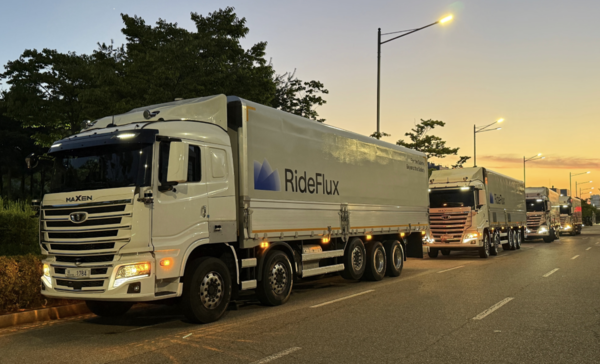
Driving data are also accumulating in the commercialization phase. RideFlux received permission from the Ministry of Land, Infrastructure and Transport for unmanned temporary operations without a safety manager in the driver’s seat and has driven more than 3,300 hours only in Seoul’s Sangam. Since July, it has also been transporting paid cargo with Hanjin using large trucks on the Gunsan-Jeonju-Daejeon route. It is a structure that produces data by operating vehicles directly instead of supplying code.
It has also added mass-production supply by installing Level 2+ driving-assistance software on Tata Daewoo Mobility’s large trucks, the Maxen and Kuxen. The function integrates control of vehicle movements, including lane keeping as well as lane changes, splitting and merging, overtaking and passing through tollgates. The calculation is to use driving records generated from sold vehicles that are not its own in Level 4 verification.
A similar race to secure data is under way overseas. The pace accelerated after Nvidia introduced its Hyperion solution for autonomous driving. Hyperion is a Drive system that integrates sensors, central computing and safety systems, removing the need for companies seeking to build autonomous vehicles to separately design sensor configurations.
After that, BYD, Geely, Isuzu and Nissan joined Level 4 programs that use the platform. Nvidia and Uber agreed to operate robotaxis in 28 markets by 2028, starting in the United States in the first half of 2027. Hyundai Motor Group also plans to use Nvidia’s solution to first apply Hyperion-based autonomous driving technology to mass-produced cars in 2028, then expand in the second half of 2029 with technology based on its self-developed Atria AI.
As each company holds different data, the timing of visible results also differs. Kakao Mobility will combine perception and decision-making into a single end-to-end model within this year. In this method, AI takes in what sensors see in full and outputs driving operations immediately, reducing behavior such as suddenly slowing down due to misperception.
RideFlux will run a publicly available robotaxi service in Sangam with the driver’s seat empty within this year, then move to fully unmanned operations by 2027. Hyundai Motor Group’s timeline is longer. It will put Nvidia-based Level 2+ into mass-produced cars in the first half of 2028, and its own Atria AI-based Level 2++ is set for the second half of 2029.
For Hyundai Motor, the first point to confirm results is an Atria AI-equipped demonstration vehicle to be deployed in Gwangju at the end of 2026. RideFlux also joined the same Gwangju autonomous driving demonstration city project. That means the two camps will use one demonstration city together. Hana Securities analysed that verification of the technology and product level, and development speed to gauge whether targets have been met, will only be possible after prototypes or mass-produced products are released.
 Daegeon Seok
d2dg@d-today.co.kr
Daegeon Seok
d2dg@d-today.co.kr