
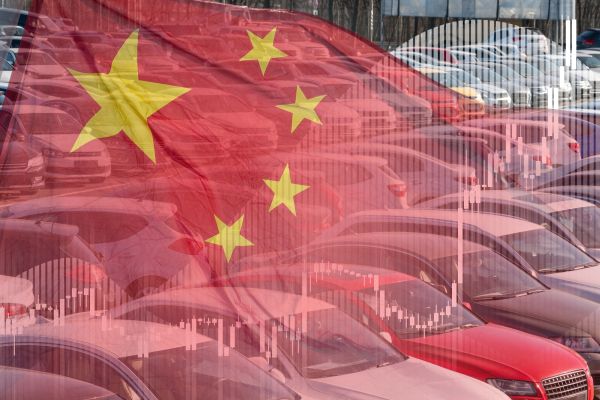
[DigitalToday reporter Jinju Hong] A claim has emerged that U.S. President Donald Trump could allow U.S. sales of Chinese-made electric vehicles (EVs) as part of negotiations with China.
Reports also said Trump has expressed an open stance toward Chinese automakers setting up local plants and producing vehicles in the United States, on the condition that they create local jobs. That marks a shift in the opposite direction from his previous position on Chinese cars entering the United States.
• Will Trump allow Chinese EVs? 'Market opening' talk emerges ahead of a Xi Jinping meeting
China's auto industry is accelerating its push into global markets with EVs while also moving to address domestic overproduction. From January to August this year, China's auto exports had already surpassed last year's full-year performance, with EVs accounting for more than half of exported vehicles.
The Chinese government has set a target of switching 70 percent of new cars to plug-in vehicles by 2030, while also speeding up industrial restructuring to resolve oversupply.
• China Jan-Aug auto exports surpass 2025 full-year result; EVs account for more than half • 70 percent of new cars to be plug-in by 2030; China moves to fix EV overproduction
Mixed signals have been detected around the U.S. EV market. As Chinese companies pour out EVs and expand competition, mentions of EVs have noticeably decreased in the U.S. auto industry. But more than half of U.S. drivers said their interest in buying an EV has grown compared with a year ago. A subtle temperature gap is emerging between suppliers and consumers in the market.
• China pours out EVs, but U.S. automakers' EV talk all but disappears • 53 percent of U.S. drivers: 'More interested in EVs than a year ago'
Moves around the Tesla Cybercab also stood out. Tesla has disclosed the Cybercab's actual production process and is speeding up mass production, while attention has also focused on a new control method found in a vehicle without a steering wheel and pedals.
With Elon Musk also detailing difficulties in the production process and signs emerging that Tesla is considering providing robotaxi loaners to service customers, Tesla is continuing moves that aim to change not only autonomous driving but also 'the way vehicles are made and operated.'
• Tesla releases Cybercab production video; parallel module assembly with 'unboxed' • No steering wheel or pedals, but a 'virtual joystick' spotted in the Tesla Cybercab • 'Thousands of times harder than a prototype': Elon Musk on Cybertruck mass-production hurdles • Left a car for service and got a robotaxi? Signs Tesla is considering robotaxi loaners for service customers
Tesla has also set Oct. 1 as the unveiling date for its next-generation Roadster. The announcement is drawing attention because it is the first time a specific unveiling date has been presented for the Roadster, which has long been delayed. Tesla has repeatedly postponed the launch since revealing the concept 10 years ago. In the meantime, the company has focused on AI, robotics and autonomous driving.
The teaser includes almost no details about the Roadster. Only a section that appears to be the taillight and 4 circular elements on the top can be seen. It has also been suggested that the device could be a cold-gas thruster developed by SpaceX.
• Tesla next-generation Roadster to be unveiled on Oct. 1; schedule confirmed after 10 years
South Korea's mobility industry is accelerating efforts to advance autonomous driving technology and expand services. Kakao Mobility is moving to secure autonomous-driving data, while Socar is expanding delivery services, broadening the competitiveness of mobility platforms.
• Kakao Mobility: 'Late-night autonomous driving data in Gangnam is a competitive edge'...E2E model integration within the year • Socar expands 'Now Delivery' morning-commute service across Seoul
McDonald's and Meituan opened China's first drone-delivery route dedicated to restaurant brands in Shanghai. The service began operating last week in the West Bund area of Xuhui district.
The route sends ordered items by drone from a McDonald's store in Xuhui district to a designated pickup kiosk. The flight distance is 3.1 km. Xuhui district authorities said the route targets demand from thousands of office workers in the area and riverside tourists.
Meituan explained that customized drones can carry up to 2.4 kg, and riverside deliveries can be completed in as little as 10 minutes.
• McDonald's burgers take to the sky...Meituan starts drone deliveries in Shanghai
A point has been raised that when evaluating EV performance, it is not enough to look only at peak output. That is because there is a difference between the maximum output shown in advertising and the output that can be sustained during actual driving. To properly compare EV performance, it is necessary to examine sustained output hidden behind a number such as '1,000 horsepower.'
• The trap of 1,000-horsepower EVs: advertised output differs from sustained output
 Jinju Hong
hongjj@d-today.co.kr
Jinju Hong
hongjj@d-today.co.kr