
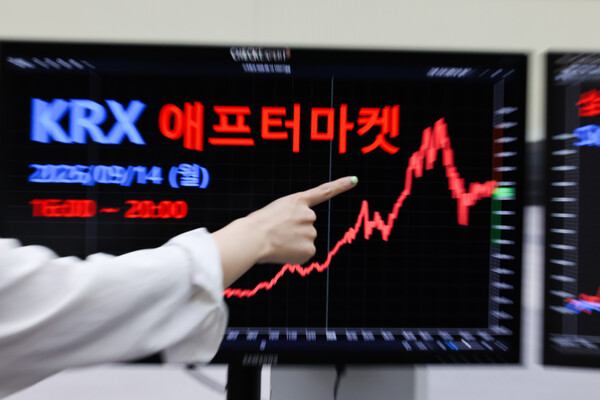
[DigitalToday reporter Sangyeop Oh (오상엽)] The Korea Exchange (KRX) after-hours market raised concerns about volatility centred on small and mid-cap shares after more than 1,000 volatility interruption (VI) triggers on its first day of trading.
The Korea Exchange said on Sept. 15 that VI was triggered a total of 1,112 times on Sept. 14, the first day of after-hours trading. There were 228 triggers on the KOSPI and 884 on the KOSDAQ. On the same day, VI triggers in the regular session totalled 391, including 70 on the KOSPI and 321 on the KOSDAQ.
VI is a price stabilisation device that halts immediate execution when a stock's price moves sharply over a short period. It collects orders for about 2 minutes and then resumes trading at a single price.
In general, VI trigger standards are applied differently by stock group or trading time depending on market liquidity and volatility levels. Even in the KRX regular session, the trigger standard for continuous trading VI is operated differently at 3 percent for KOSPI200 components and 6 percent for other stocks.
Because after-hours markets have lower liquidity than the regular session, VI trigger standards are generally eased. But the Korea Exchange applied the same standards as the regular session to secure initial market stability, considering recent increases in stock market volatility and that the after-hours market is being operated for the first time.
After-hours turnover on the first day was 180 billion won, about 7 percent of the 2.57 trillion won in the regular session. The exchange explained that the number of triggers increased because it applied the same VI standards despite relatively small turnover.
The larger number of stocks eligible for trading in the after-hours market than on NextTrade (NXT) also affected the number of VI triggers. Unlike NXT, which trades mainly in 604 high-liquidity stocks, the KRX after-hours market allows trading in 2,472 stocks, including low-liquidity issues.
On the first day, prices of some small and mid-sized issues also moved sharply. Related reports said VI was triggered 19 times for SG Healthcare, 18 times for Daeho Special Steel, and 15 times each for InnoAX and Hankchang Paper. With thinner order books than the regular session, even small orders moved prices sharply, raising concerns among investors about a lack of liquidity.
The exchange said VI trigger counts should be viewed separately from actual market volatility.
High-low volatility calculated using each stock's intraday high and low fell to 2.9 percent in after-hours trading from 4.1 percent in the regular session for the KOSPI. The KOSDAQ also recorded 4.6 percent in after-hours trading, lower than 5.8 percent in the regular session.
The exchange explained that frequent VI triggers themselves were the result of price discovery functioning, preventing immediate execution of orders that would cause sharp swings and allowing market participants to find appropriate prices.
It also operates market makers dedicated to the after-hours market. The measure is intended to supplement liquidity and induce price stability by supplying bid and offer quotes for low-liquidity stocks and others.
The Korea Exchange plans to continue checking after-hours trading and VI trigger conditions going forward.
The Korea Exchange said, "Volatility increased in some stocks, but overall after-hours prices were formed more stably than in the regular session," and "We will closely monitor market conditions and actively gather market opinions while focusing on establishing the after-hours market."
 Sangyeop Oh
yub@d-today.co.kr
Sangyeop Oh
yub@d-today.co.kr